





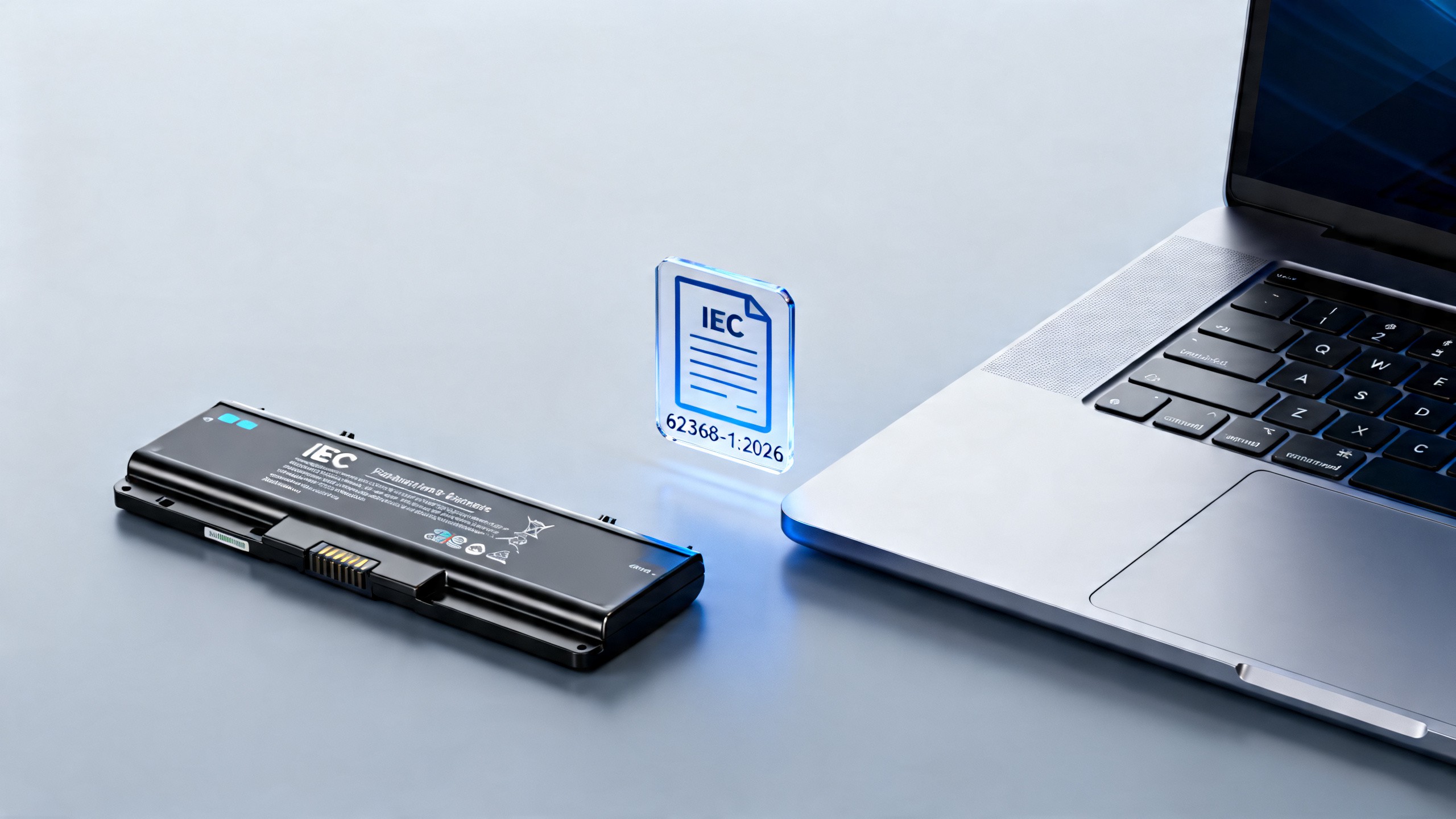
On April 15, 2026, the International Electrotechnical Commission (IEC) officially published the new edition of the safety standard IEC 62368-1:2026 for audio/video and information technology equipment. This update directly affects Chinese manufacturers and exporters of AV/IT devices targeting markets including the EU, Canada, and South Korea — requiring full compliance by March 31, 2027.
Event Overview
The IEC released IEC 62368-1:2026 on April 15, 2026, superseding the 2018 edition. The updated standard introduces enhanced requirements for thermal runaway prevention, battery safety, and cybersecurity interfaces. Exporters of audio/video and IT equipment from China must complete product modifications and certification updates before March 31, 2027, to maintain market access in all 32 IEC member countries that recognize this standard.
Industries Affected by Segment
Direct Exporters (OEM/ODM Manufacturers)
These enterprises are directly responsible for product conformity and certification submission. They face immediate technical and timeline pressure: non-compliant products will be barred from shipment to key export markets after Q1 2027. Impact includes redesign cycles, retesting costs, and potential delays in order fulfillment.
Component & Battery Suppliers
Suppliers providing lithium-based batteries, power modules, or thermally sensitive subassemblies may see revised specification demands — especially around thermal propagation resistance and cell-level safety documentation. Their impact is indirect but operationally significant: failure to meet updated component-level criteria can delay whole-product certification.
Contract Manufacturers & EMS Providers
These firms handle production under client specifications. They must verify whether incoming BOMs and design files align with IEC 62368-1:2026 requirements — particularly for battery integration, enclosure ventilation, and interface labeling. Non-alignment risks production stoppages or rejected batches during third-party audits.
Distribution & Certification Service Providers
Importers, regional distributors, and conformity assessment bodies (e.g., notified bodies) will need to validate updated test reports and certificates. Their role shifts toward stricter pre-shipment verification — increasing administrative workload and potentially extending time-to-market for new models.
What Enterprises Should Focus On & How to Respond
Monitor official national transposition timelines
While IEC 62368-1:2026 is now published, adoption into national standards (e.g., EN IEC 62368-1 in the EU, CSA C22.2 No. 62368-1 in Canada) may follow staggered schedules. Enterprises should track official announcements from national standards bodies — not assume automatic alignment with the IEC release date.
Prioritize high-volume, high-risk product categories
Analysis来看, portable devices with integrated lithium-ion batteries (e.g., wireless speakers, laptops, streaming sticks) face the most stringent revisions — especially regarding thermal runaway testing and battery management system (BMS) interface documentation. These should be prioritized in internal gap assessments.
Distinguish regulatory signal from operational readiness
From industry角度看, the April 2026 publication serves primarily as a formal trigger — not an immediate enforcement date. However, certification bodies have already begun accepting pre-assessment submissions. Enterprises should treat Q4 2026 as the de facto deadline for initiating certification applications to avoid bottlenecks.
Update procurement and documentation workflows now
Current more suitable understanding is that supplier declarations, material safety data sheets (MSDS), and battery test reports must reflect 2026-edition criteria. Procurement teams should revise vendor evaluation checklists and require updated compliance statements — starting no later than Q3 2026.
Editorial Perspective / Industry Observation
Observation来看, IEC 62368-1:2026 functions less as a standalone technical revision and more as a coordinated market gatekeeping mechanism across 32 jurisdictions. It consolidates emerging risk domains — notably thermal safety in compact battery-powered devices and minimal cybersecurity interface expectations — into mandatory conformity pathways. This signals a structural shift: safety certification is increasingly converging with functional resilience requirements. From industry perspective, it reflects growing regulatory emphasis on lifecycle risk anticipation rather than static hazard control. Continuous monitoring remains essential, as national adoptions may introduce minor deviations in scope or transition periods.
Conclusion: This update is neither a distant policy horizon nor an abrupt cutoff — it marks a defined, enforceable inflection point for AV/IT device exports. Its significance lies not in novelty alone, but in its binding effect across major trade partners. Enterprises are advised to treat the 2026–2027 window as a fixed compliance cycle — not a flexible guideline period.
Source: International Electrotechnical Commission (IEC) — Official Publication Notice for IEC 62368-1:2026 (April 15, 2026). Note: National transposition status and certification body acceptance policies remain subject to ongoing observation and are not yet fully confirmed across all 32 IEC member countries.
Related News
- IEC 62368-1:2026 Published — AV/IT Exporters Must Comply by Q1 2027Apr 16, 2026IEC 62368-1:2026 is live — AV/IT exporters must comply by Q1 2027. Discover key changes, affected industries, and actionable compliance steps now.
- USTR Launches 301 Review on Chinese Smart WearablesApr 16, 2026USTR 301 review on Chinese smart wearables signals new tariffs & stricter compliance—key for exporters, OEMs, and suppliers. Act now.
- Vietnam Enforces Bilingual Energy Labeling for EEE ProductsApr 16, 2026Vietnam enforces bilingual energy labeling for EEE products—Vietnamese & Chinese required. Key for Chinese exporters of power adapters, LED lights, and appliances. Act now to avoid penalties!
- EU CBAM Transition Rules Finalized: Data Submission by Apr 30Apr 16, 2026EU CBAM transition rules are live: Chinese steel, aluminum & cement exporters must submit verified carbon data by Apr 30. Act now to avoid customs delays and penalties.
Related News
- 00
0000-00
Indonesia Mandates CNAS Lab Reports for Imported Building Materials from July 2026 - 00
0000-00
China's CPO Optical Module Exports Up 41%; Eoptolink First Global Vendor on US AI Infrastructure White List - 00
0000-00
IEC 62368-1:2026 Published — AV/IT Exporters Must Comply by Q1 2027 - 00
0000-00
Red Sea Tensions Lift Asia-Europe Freight Costs 23% Weekly - 00
0000-00
RCEP e-CO Platform Launches for Faster Export Clearance
Policy Review Desk
Weekly Insights
Stay ahead with our curated technology reports delivered every Monday.