





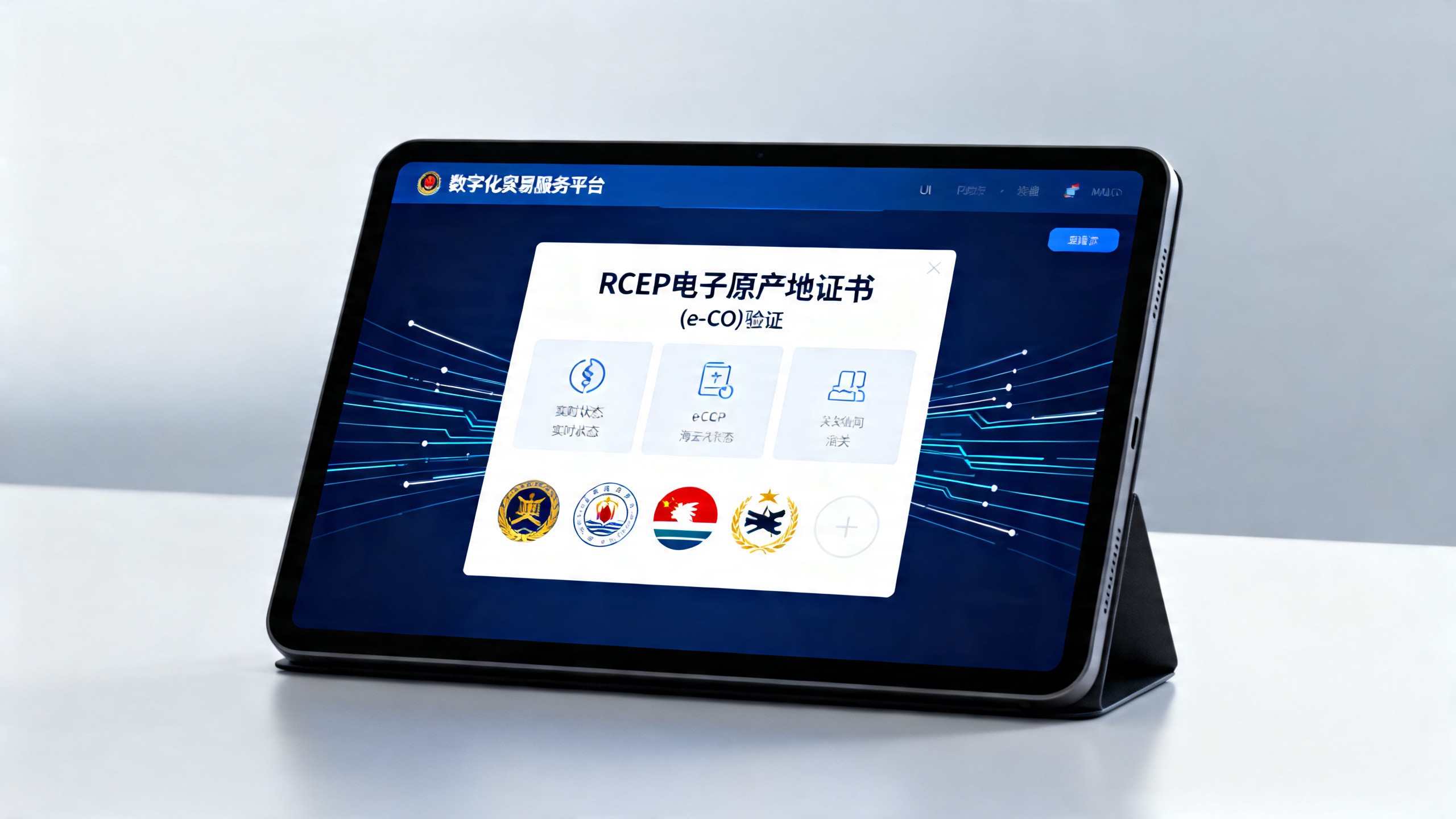
RCEP member countries launched a unified electronic Certificate of Origin (e-CO) platform on April 15, 2026. This development significantly accelerates customs clearance for Chinese exporters—especially in machinery parts, textiles, and food additives—by enabling real-time cross-border verification of origin certificates and cutting average waiting times by 60%. Companies engaged in export trade to RCEP markets should assess operational readiness for digital certificate adoption and compliance validation.
Event Overview
On April 15, 2026, the ASEAN Secretariat, together with China, Japan, South Korea, Australia, New Zealand, and the ten ASEAN member states, officially launched the RCEP Electronic Certificate of Origin (e-CO) mutual recognition platform. Under this system, Chinese exporters issuing e-COs can have their certificates verified in real time by customs authorities in any RCEP participating country. The platform initially covers 37 high-frequency export categories, including mechanical components, textile products, and food additives.
Impact on Specific Industry Segments
Direct Exporters
These enterprises are directly affected because e-CO issuance and verification now determine customs release speed and tariff eligibility. Impact manifests in reduced documentation delays, lower risk of origin-related rejections at destination ports, and tighter alignment required between export declarations and upstream supply chain records.
Raw Material Procurement Firms
Suppliers sourcing inputs for RCEP-bound exports must ensure traceability and origin documentation supports downstream e-CO claims. Inconsistencies—such as unverified supplier declarations or missing batch-level origin data—may delay or invalidate e-CO applications filed by their customers.
Contract Manufacturers & OEMs
Manufacturers producing goods under foreign brand labels face heightened scrutiny on regional value content (RVC) calculations and production process documentation. Since e-CO validation relies on digital audit trails, firms lacking granular BOM-level origin tracking may encounter verification failures despite physical compliance.
Distribution & Trading Companies
Trading intermediaries handling multi-country shipments must now coordinate e-CO issuance across multiple jurisdictions—even when consolidating goods from different suppliers. Delays or mismatches in certificate timing or data fields (e.g., HS code, invoice number, consignee details) can stall entire container releases.
Supply Chain Service Providers
Logistics platforms, customs brokers, and digital trade solution vendors need to integrate with the new e-CO platform’s API or portal interface. Lack of compatibility may limit service scope for clients targeting RCEP markets, especially where paper-based fallbacks are no longer accepted.
What Relevant Enterprises or Practitioners Should Focus On
Monitor official implementation guidelines from national customs authorities
While the platform is live, each RCEP country may issue distinct procedural requirements—for example, acceptable digital signature formats, mandatory fields, or transitional deadlines for paper submissions. Businesses should track updates from China’s General Administration of Customs (GACC), Japan’s Ministry of Finance, or ASEAN national customs portals.
Verify coverage of priority product lines and target markets
The initial rollout includes 37 commodity categories—but not all HS codes within those categories may be enabled. Exporters should confirm whether their specific 10-digit HS codes are supported in key destinations (e.g., Vietnam for textiles, Thailand for food additives) before committing to e-CO–only workflows.
Distinguish between policy launch and operational readiness
The platform’s go-live date does not imply universal technical interoperability. Some national customs systems may still require manual reconciliation or exhibit latency in certificate status updates. Treat early-stage deployments as pilot conditions—not full automation—and retain parallel verification protocols during the first quarter of operation.
Align internal documentation systems with e-CO data requirements
Successful e-CO issuance depends on consistent data across commercial invoices, packing lists, and production records—including precise consignee names, addresses, and invoice numbers matching those submitted to the platform. Firms should conduct internal data-mapping exercises to identify gaps before scaling usage.
Editorial Perspective / Industry Observation
From industry perspective, this platform launch is better understood as an infrastructure signal—not yet a fully realized operational outcome. Its immediate value lies in standardizing digital expectations across RCEP markets, but actual efficiency gains depend on national system maturity, cross-border data synchronization, and enterprise-level integration capacity. Observers should track whether subsequent quarters show measurable reductions in origin-related customs holds or increased rejection rates due to data mismatch—both of which would indicate whether the platform is functioning as intended or exposing underlying compliance fragility.
Conclusion
This initiative marks a structural shift toward interoperable digital trade infrastructure within the RCEP bloc. For exporters and supply chain actors, it signals growing reliance on verifiable, machine-readable origin data—not just paper-based declarations. However, its current impact remains conditional: meaningful benefits emerge only where enterprises align internal processes with platform requirements and where national customs systems operate reliably in concert. It is more accurately interpreted as the beginning of a phased digital transition—not an immediate, frictionless upgrade.
Information Sources
Main source: Official joint announcement by the ASEAN Secretariat and RCEP national trade authorities, released April 15, 2026.
Note: Ongoing monitoring is advised for national implementation timelines, technical specifications, and expansion of covered HS codes beyond the initial 37 categories.
Related News
- RCEP e-CO Platform Launches for Faster Export ClearanceApr 16, 2026RCEP e-CO Platform launches April 2026—boosting export clearance for machinery, textiles & food additives. Cut waiting times by 60% with real-time origin verification.
- China's Q1 2026 Export Structure Upgrades: 'New Three' Reach 58.3%Apr 16, 2026China's Q1 2026 export structure upgrades: 'New Three' (EVs, lithium batteries, solar cells) hit 58.3% — key insights for importers, OEMs & supply chain pros.
- Biodegradable packaging isn’t always greener — here’s where it fails in real-world logisticsApr 16, 2026Biodegradable packaging fails in real logistics—discover why coating materials, rubber materials & plastic resins fall short. Get data-driven insights on label materials, paper packaging & specialty chemicals.
- Investment trends in Asian manufacturing hubs show divergence — not just growthApr 16, 2026Explore global sourcing trends, smart manufacturing news & investment trends shaping Asia’s divergent factory landscape—get actionable buyer market analysis & sourcing insights now.
Related News
- 00
0000-00
Indonesia Mandates CNAS Lab Reports for Imported Building Materials from July 2026 - 00
0000-00
China's CPO Optical Module Exports Up 41%; Eoptolink First Global Vendor on US AI Infrastructure White List - 00
0000-00
IEC 62368-1:2026 Published — AV/IT Exporters Must Comply by Q1 2027 - 00
0000-00
Red Sea Tensions Lift Asia-Europe Freight Costs 23% Weekly - 00
0000-00
RCEP e-CO Platform Launches for Faster Export Clearance
Global Trade Insights Desk
Weekly Insights
Stay ahead with our curated technology reports delivered every Monday.