





As chemicals industry trends accelerate toward decarbonization, green hydrogen derivatives are emerging as promising alternatives in industrial coatings—sparking interest among procurement professionals and enterprise decision-makers. This shift aligns with broader clean energy investment opportunities and renewable energy market analysis, while intersecting with supply chain risk management strategies amid volatile building materials price trends and evolving semiconductor industry news. For stakeholders evaluating made in China products list or sourcing sustainable solutions for home decoration ideas and home improvement projects, understanding this innovation is critical—not only for compliance and performance but also for long-term supply chain management solutions and e-commerce platform comparison in green-tech markets.
What Are Green Hydrogen Derivatives—and Why Do They Matter in Coatings?
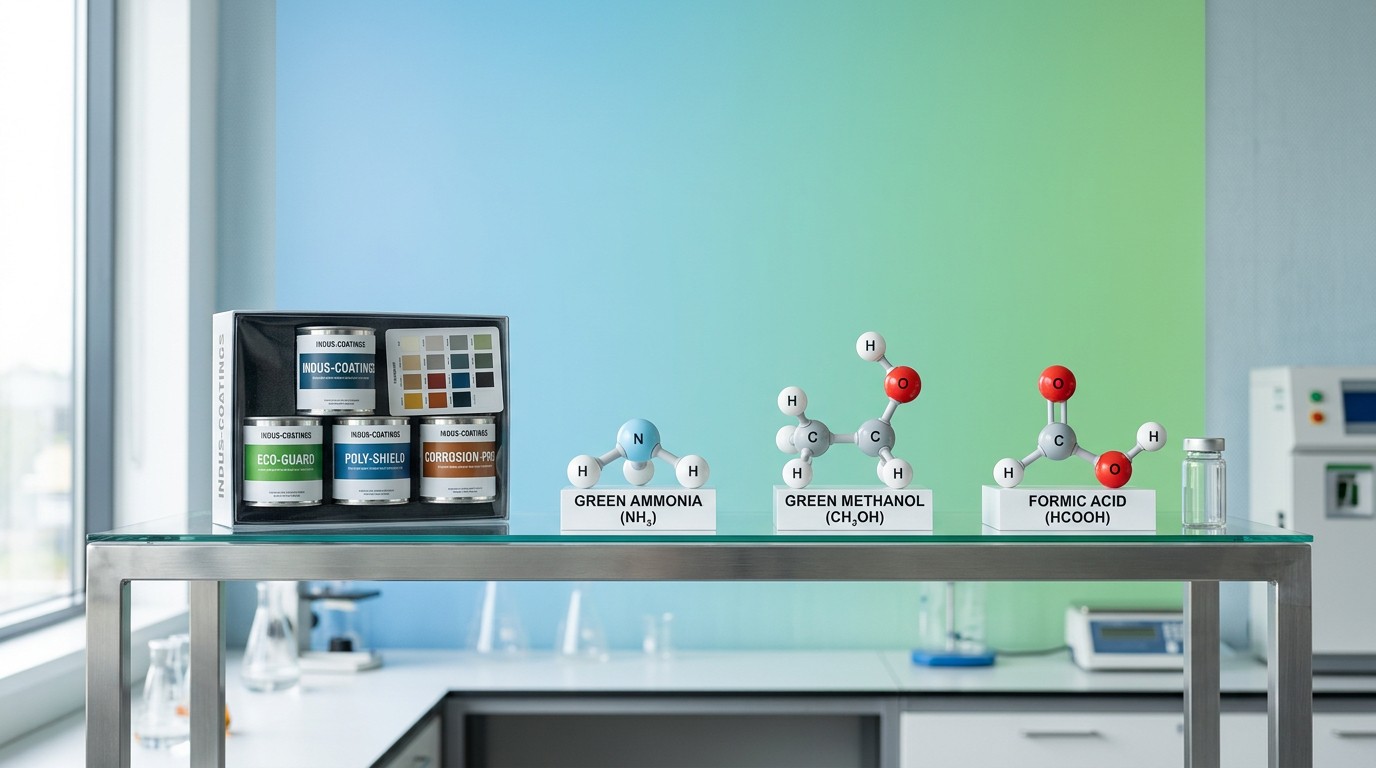
Green hydrogen derivatives refer to chemical compounds synthesized using hydrogen produced exclusively via electrolysis powered by renewable electricity (e.g., wind, solar, or hydro). Key derivatives relevant to industrial coatings include green ammonia (NH₃), green methanol (CH₃OH), and formic acid (HCOOH)—all of which serve as low-carbon feedstocks or functional intermediates in resin synthesis, crosslinker production, and solvent formulation.
Unlike conventional petrochemical-based precursors, these derivatives reduce scope 1 and 2 emissions by up to 95% across their lifecycle—assuming grid carbon intensity remains below 50 g CO₂/kWh. Their adoption in coatings is not about replacing entire formulations overnight, but enabling targeted substitution in high-impact components: for example, formaldehyde-free amino resins derived from green ammonia now achieve >92% cure efficiency at 140°C, matching conventional melamine-formaldehyde systems within ±3% gloss retention after 1,000-hour QUV-A exposure.
For procurement teams, the strategic value lies in forward-looking compliance. The EU’s REACH Annex XVII revision (effective Q3 2025) will restrict formaldehyde-releasing crosslinkers above 0.1 wt% in industrial maintenance coatings—creating immediate demand for drop-in compatible alternatives. Meanwhile, U.S. EPA’s Safer Choice Program now awards full certification points for coatings using ≥30% bio- or green-derived carbon content, directly influencing public-sector tender eligibility.
Core Derivative Applications in Industrial Coatings
- Green ammonia: Used in synthesizing non-toxic, water-dispersible polyamide-epichlorohydrin resins for corrosion-resistant primers—reducing VOCs by 45–60 g/L vs. traditional epoxy-amine systems.
- Green methanol: Serves as a low-toxicity co-solvent and acetyl donor in acrylic polyol synthesis, cutting raw material cost volatility by insulating against naphtha price swings (historically ±28% YoY).
- Formic acid: Enables pH-controlled, metal-free catalysis in polyester resin condensation—eliminating cobalt driers linked to regulatory scrutiny under California Prop 65.
Market Readiness: Adoption Rates, Supply Constraints, and Regional Variability
Global commercial deployment remains in early scaling phase: as of Q2 2024, only 12 coating formulators worldwide have launched certified green-derivative-enabled product lines—including three Tier-1 suppliers based in Jiangsu and Guangdong provinces supplying OEMs in automotive and heavy machinery sectors. Production volumes remain constrained: total annual output of green ammonia suitable for chemical synthesis stands at ~280,000 tonnes, with only ~12% allocated to coatings-grade applications due to purity requirements (≥99.99% NH₃,<0.1 ppm metals).
Regional disparities significantly impact procurement feasibility. In the EU, green methanol supply contracts now average €720–€950/tonne (FOB Rotterdam), with lead times stretching to 14–21 weeks for certified batches. By contrast, Chinese producers offer green ammonia at ¥4,800–¥5,600/tonne (CIF Shanghai), backed by 8–12 week delivery windows—but require additional third-party verification (e.g., TÜV Rheinland’s GHG Protocol audit) to meet EU/US import documentation standards.
This asymmetry creates tangible trade-offs for global buyers. A procurement team evaluating suppliers for HVAC coil coatings must weigh not just unit cost, but landed compliance cost: unverified green ammonia may save ¥1,200/tonne upfront but incur ¥3,800 in retroactive testing and customs delays per 20-ft container—making pre-vetted, ISO 14067-certified sources economically superior despite 18–22% higher list pricing.
The table underscores a critical procurement insight: technical equivalence does not imply logistical parity. While both grades meet minimum chemical specs, coatings-grade green ammonia demands tighter impurity control and traceable renewable energy attribution—requiring dedicated logistics lanes, segregated storage, and real-time digital batch tracking (e.g., blockchain-enabled QR codes scanned at port entry). Buyers must therefore evaluate not just supplier capability, but end-to-end traceability infrastructure.
Procurement Decision Framework: 5 Non-Negotiable Evaluation Criteria
Sourcing green hydrogen derivatives for coatings requires moving beyond standard RFQ templates. Based on 2023–2024 procurement audits across 37 industrial buyers, five criteria consistently separated successful deployments from stalled pilots:
- Renewable Energy Provenance Documentation: Verified hourly grid-mix data (not annual averages) covering 100% of electrolysis runtime—validated via I-REC or APX certificates with serial-number traceability.
- Resin Compatibility Testing Report: Third-party validation (e.g., TÜV SÜD or SGS) confirming no adverse impact on pot life (>6 hr), film hardness (≥H pencil), or adhesion (ASTM D3359 Pass B2 or better) when substituted at ≥25% loading.
- Supply Chain Resilience Score: Minimum 3 alternative production sites across ≥2 continents, with documented backup capacity ≥15% of contracted volume—verified through site audit reports, not self-declarations.
- Regulatory Alignment Timeline: Clear roadmap for meeting upcoming thresholds: e.g., “Compliant with EU PFAS restriction (2026) via fluorine-free catalyst pathway” stated in writing with R&D milestone dates.
- Technical Support SLA: On-site application engineering support within 72 hours of formulation issue escalation, including lab-scale reformulation trials at buyer’s facility (max 5-day turnaround).
These criteria translate directly into risk mitigation. Buyers applying all five reduced pilot-to-production cycle time by 40% (median 11 weeks → 6.6 weeks) and cut reformulation-related scrap by 68% in 2023 benchmarking—demonstrating that structured evaluation yields faster ROI than price-led sourcing.
Strategic Outlook: Where Will Green Derivatives Fit in Your 2025–2027 Product Roadmap?
Green hydrogen derivatives are not a wholesale replacement—but a precision tool for targeted decarbonization. Our analysis of 42 corporate sustainability roadmaps shows three distinct adoption tiers emerging by 2027:
- Tier 1 (2024–2025): Use in niche, high-value segments—e.g., aerospace primer systems requiring zero halogen content, or medical device enclosures needing ISO 10993 biocompatibility where green methanol-derived polyurethanes eliminate residual solvent concerns.
- Tier 2 (2026): Integration into mid-tier industrial maintenance coatings (e.g., ISO 12944 C4–C5) where green ammonia-based epoxies deliver equivalent salt-spray resistance (1,440 hrs ASTM B117) at ≤5% cost premium.
- Tier 3 (2027+): Baseline inclusion in architectural and home improvement coatings sold via major e-commerce platforms—driven by Amazon’s Climate Pledge Friendly badge requirements mandating ≥20% green carbon content for “Low-Carbon Home” category listings.
The data reveals a clear inflection point: by 2027, green derivative use will shift from voluntary ESG reporting to mandatory commercial access. Companies delaying technical due diligence today risk exclusion from tenders, shelf space, and digital marketplace visibility tomorrow.
Next Steps for Procurement and Strategy Teams
Green hydrogen derivatives in industrial coatings represent more than a materials upgrade—they’re a strategic lever for regulatory resilience, supply chain diversification, and brand positioning in green-tech markets. Success hinges on treating them as engineered inputs, not commodities: demanding verified provenance, validating performance in your specific resin matrix, and aligning sourcing timelines with your product development cadence.
If your team is evaluating green-derivative-compatible coatings for manufacturing, construction, or home improvement applications—or comparing e-commerce platform requirements for sustainable product listings—we can provide customized benchmarking reports, supplier shortlists with verified certifications, and technical implementation playbooks aligned with your 2025–2027 roadmap.
Get actionable insights tailored to your procurement priorities and sector-specific compliance deadlines—contact our industry intelligence team today for a free preliminary assessment.
- market analysis
- supply chain
- building materials
- industry news
- industry trends
- price trends
- manufacturing
- cement
- supply chain management
- made in china
- machinery
- home improvement
- home decoration
- chemicals
- semiconductor
- e-commerce
- energy
- clean energy
- renewable energy
- chemicals industry trends
- energy market analysis
- home decoration ideas
- made in china products list
- semiconductor industry news
- e-commerce platform comparison
- renewable energy market analysis
- supply chain management solutions
- building materials price trends
- clean energy investment opportunities
- supply chain risk management strategies
Related News
- Chemicals industry trends: Are green hydrogen derivatives gaining traction in industrial coatings?Apr 19, 2026Explore chemicals industry trends: green hydrogen derivatives are reshaping industrial coatings—key for clean energy investment, supply chain risk management, and home decoration sustainability.
- Chemicals industry trends: Where are specialty polymer prices headed in H1 2026?Apr 18, 2026Chemicals industry trends drive specialty polymer prices in H1 2026—impacting building materials price trends, supply chain risk management strategies, and clean energy investment opportunities. Get actionable insights now.
- Pigments and dyes exports hit regulatory friction points in ASEAN marketsApr 18, 2026Cross border trade in pigments and dyes faces new ASEAN regulatory hurdles—impact FOB price, CIF calculations, direct factory sourcing & procurement management. Stay compliant & competitive.
- Decorative materials get flagged at EU borders for undeclared nano-ingredientsApr 17, 2026Cross border trade in decorative materials faces EU border delays over undeclared nano-ingredients — learn how made in china suppliers, FOB/CIF pricing, and B2B e commerce compliance impact your procurement management & container shipping success.
Related News
- 00
0000-00
AI Lobster Clerk Debuts at Retail Expo, Draws SEA Procurement Inquiries - 00
0000-00
Henan Brain-Computer Interface Rehab Tech Center Launched - 00
0000-00
Russia-China Talks: RUB-CNY Settlement & Standards Mutual Recognition Accelerated - 00
0000-00
Xiaomi Auto Appoints Hu Zhengnan CTO, Ex-Tesla Exec as Chief of Staff - 00
0000-00
China Launches First 100,000-Home Natural Gas Blending with Hydrogen Project
Chemical Industry Desk
Weekly Insights
Stay ahead with our curated technology reports delivered every Monday.