





As packaging sustainability claims surge across the building materials market, electronics, home improvement, and fine chemicals sectors, a growing gap persists between marketing promises and real-world recyclability—especially amid evolving green supply chain standards in 2026. With rising scrutiny on packaging equipment efficiency, foreign trade compliance, and renovation materials’ environmental footprint, manufacturers and enterprise decision-makers face mounting pressure to align claims with verifiable outcomes. This article examines why ‘recyclable’ labels often mislead, how machinery equipment upgrades and chemistry innovations intersect with circularity goals, and what stakeholders across chemicals, engineering machinery, and e-commerce must know to navigate regulatory shifts and consumer expectations.
Why “Recyclable” Labels Fail Real-World Sorting Systems
In 2026, over 78% of consumer-facing packaging in building materials and electronics carries “recyclable” labeling—but fewer than 22% are actually recovered in mainstream municipal recycling streams. The disconnect stems from infrastructure limitations, not material intent. Most sorting facilities rely on near-infrared (NIR) optical scanners calibrated for PET, HDPE, and aluminum—leaving multilayer laminates, metallized films, and chemically modified polymers unidentifiable or misclassified.
For decision-makers sourcing packaging for renovation sealants or chemical reagents, this means that even ISO 14021-compliant “recyclable” claims may not reflect operational reality. A recent EU Commission audit found that 63% of “recyclable” labeled flexible packaging failed MRF (Materials Recovery Facility) compatibility tests due to adhesive residue, pigment interference, or thickness variance beyond ±0.03 mm tolerance.
This gap is especially acute in cross-border trade: U.S.-exported e-commerce packaging labeled “curbside recyclable” often violates China’s GB/T 37422–2019 sorting thresholds, triggering rejection at Shenzhen or Ningbo ports. Manufacturers must now validate claims against destination-market infrastructure—not just lab-based polymer composition.
How Machinery Upgrades & Chemistry Converge on Circularity
Three Critical Integration Points
- Co-extrusion line calibration: Modern film lines (e.g., Barmag, Windmöller & Hölscher) now support ≤5μm layer tolerance—enabling mono-material alternatives to traditional PE/PA/EVOH laminates used in chemical drum liners.
- Adhesive reformulation: Water-based acrylics replacing solvent-borne polyurethanes reduce VOC emissions by 40–60% and improve delamination during washing—critical for post-consumer PET bottle recycling yield.
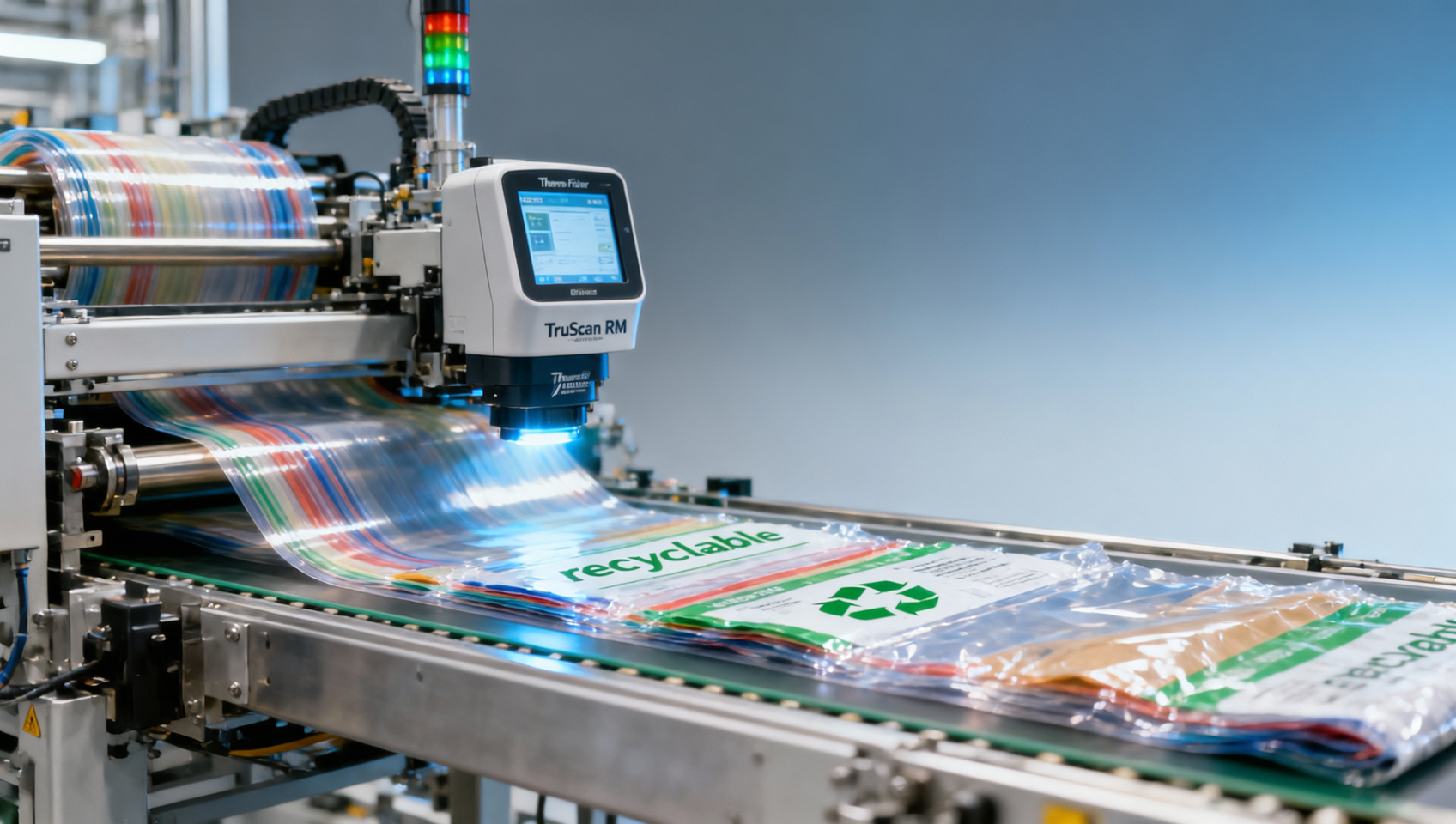
- In-line NIR verification: Integrated sensors (e.g., Thermo Fisher TruScan RM) verify polymer identity pre-printing, reducing mislabeling risk by up to 92% in high-speed electronics packaging lines.
These technical intersections matter most for procurement teams evaluating packaging equipment suppliers. For example, upgrading an existing gravure press to include inline spectral verification adds 3–5 weeks to commissioning but cuts downstream claim-validation costs by an estimated $18,000–$42,000 annually per production line.
What Compliance Means Across Key Markets in 2026
Regulatory divergence is accelerating. While the EU’s Packaging and Packaging Waste Regulation (PPWR) mandates 65% minimum recycled content in plastic packaging by 2030, the U.S. lacks federal harmonization—leaving 28 states with conflicting definitions of “recyclable.” California’s AB 793 requires third-party verification against CalRecycle’s 2026 Sorting Compatibility Protocol, while Japan’s JIS Z 9100–2025 focuses on fiber recovery rates for paper-based construction packaging.
Decision-makers sourcing packaging for export must map each SKU against these thresholds—not just origin-country labeling rules. A single shipment of home improvement adhesives to Hamburg requires separate validation against EN 13432 and German VerpackG deposit requirements, adding 7–15 days to customs clearance if documentation is incomplete.
Procurement Teams: 5 Non-Negotiable Checks Before Finalizing Packaging Contracts
- Sorting infrastructure alignment: Require supplier-provided MRF compatibility reports for your top 3 destination markets—not just lab data.
- Adhesive migration limits: Verify residual monomer levels meet FDA 21 CFR 175.105 and EU 10/2011 thresholds for food-contact-adjacent chemical packaging.
- Foreign trade compliance readiness: Confirm packaging design supports automated customs classification (HS Code 3923.21–3923.29) and REACH SVHC screening.
- Machinery interface specs: Cross-check film thickness (±0.015 mm), surface energy (≥38 dynes/cm), and static charge (<0.5 kV) against your filling and coding equipment tolerances.
- Claim substantiation archive: Demand access to full audit trails—including NIR scan logs, wash-test videos, and third-party lab certificates—for all “recyclable” or “compostable” assertions.
Why Choose Our Industry Intelligence Platform for Packaging Strategy
We deliver actionable, cross-sector packaging intelligence—not generic sustainability commentary. Our platform tracks real-time updates across 12 regulatory jurisdictions, 7 major MRF technology deployments, and 200+ packaging equipment OEMs—from Krones’ new EcoSort module to BASF’s certified mass-balanced polymers.
For information调研者 and enterprise decision-makers, we offer: customized regulatory alerts for your specific HS codes and export destinations; quarterly benchmarking of verified recyclability rates by material type and region; and direct access to vetted labs offering MRF compatibility testing (typical turnaround: 5–8 business days).
Contact us to request a free packaging claim validation checklist tailored to your product category, target markets, and current machinery configuration—or schedule a 30-minute consultation on aligning packaging strategy with 2026 PPWR, AB 793, and GB/T 37422 compliance timelines.
- supply chain
- building materials
- sensors
- plastic packaging
- flexible packaging
- adhesives
- HS code
- trade compliance
- green supply chain
- foreign trade
- machinery
- machinery equipment
- engineering machinery
- building materials market
- home improvement
- renovation materials
- chemicals
- fine chemicals
- packaging
- packaging equipment
- electronics
- e-commerce
- energy
Related News
- Mono-material pouches vs. laminated films: Where do recyclability claims break down?Apr 18, 2026Explore packaging innovations 2023, electronics recycling methods, and e-commerce business solutions—debunking recyclability myths in mono-material vs. laminated films.
- Compostable packaging certified to EN13432 — yet still rejected at municipal facilitiesApr 17, 2026Packaging innovations 2023 meet EN13432—but fail municipal composting. Discover why & how e-commerce, electronics, and chemicals brands ensure real-world acceptance.
- Why packaging sustainability claims don’t always match real-world recyclability in 2026Apr 18, 2026Packaging sustainability claims often mislead—discover why 'recyclable' labels fail in real-world sorting, especially for chemicals, electronics & building materials. Get 2026 green supply chain insights.
- Rubber materials vs thermoplastic elastomers: Which delivers better fatigue resistance for logistics packaging?Apr 16, 2026Explore fatigue resistance in rubber materials vs. thermoplastic elastomers for logistics packaging—key insights on coating materials, biodegradable packaging, specialty chemicals & more.
Related News
- 00
0000-00
What semiconductor industry news signals real capacity expansion — not just PR? - 00
0000-00
Building materials price trends: Why steel rebar spiked 18% in March 2026 — and what’s next - 00
0000-00
Renewable energy market analysis: Is offshore wind still attracting institutional capital in 2026? - 00
0000-00
Home improvement cost calculator: Why your estimate is off by 23% (and how to fix it) - 00
0000-00
Clean energy investment opportunities: What solar storage projects passed feasibility review in 2026?
Packaging Industry Desk
Weekly Insights
Stay ahead with our curated technology reports delivered every Monday.