





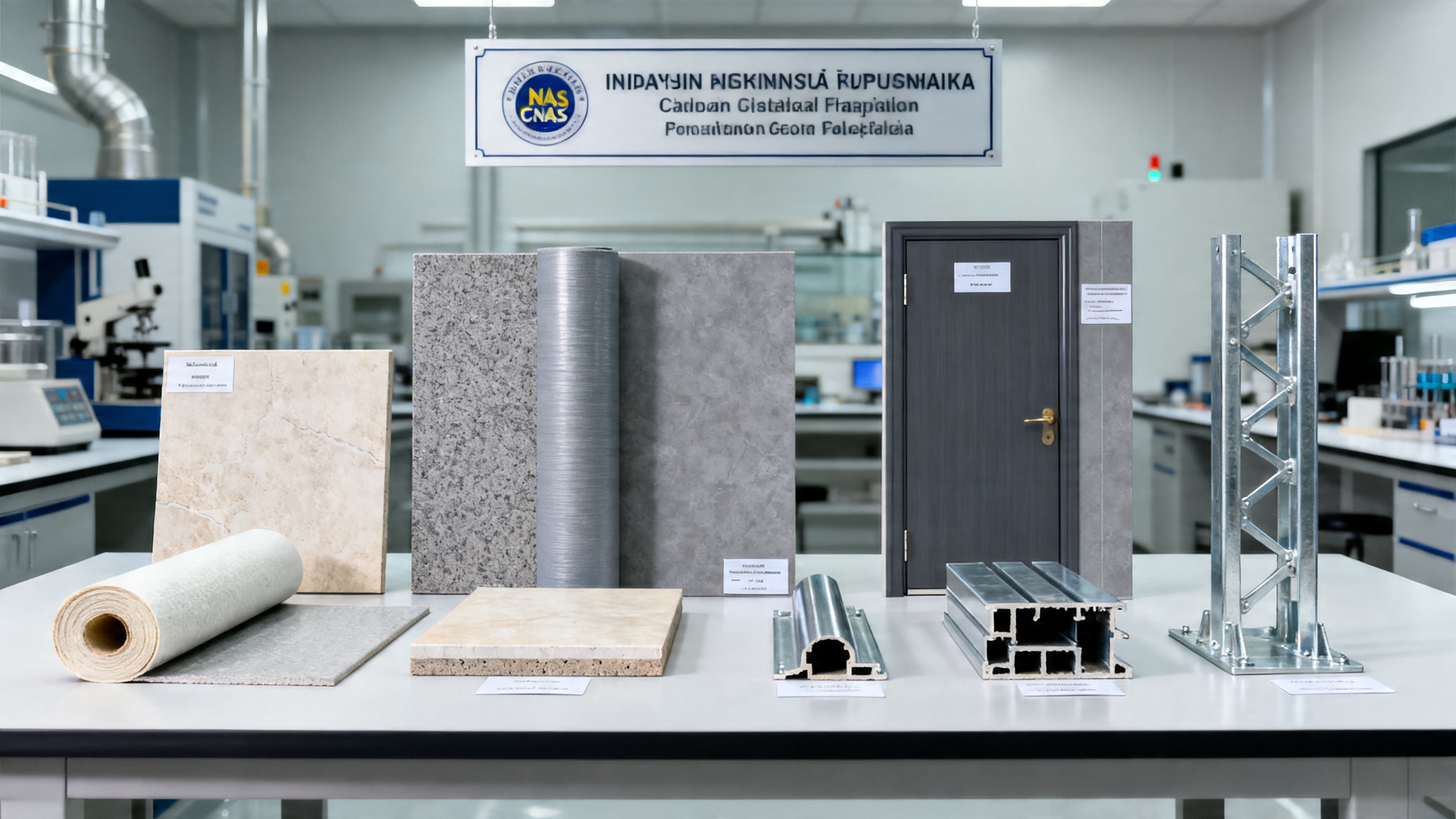
Effective 1 July 2026, Indonesia’s Ministry of Industry will require all imported building ceramics, waterproofing materials, fire-rated doors, and metal framing systems to be accompanied by third-party test reports issued by laboratories accredited by China’s China National Accreditation Service (CNAS). This regulatory shift directly affects exporters, distributors, and manufacturers in the construction materials supply chain serving the Indonesian market — particularly those based in China without CNAS-recognized testing capacity.
Event Overview
On 11 April 2026, Indonesia’s Ministry of Industry issued Regulation No. 12/2026, stipulating that, starting 1 July 2026, importers of specified building materials must submit test reports from CNAS-accredited laboratories. The reports must include an Indonesian-language summary and a verifiable anti-counterfeiting QR code. The regulation has already prompted several major Jakarta-based distributors to revise their supplier qualification criteria, explicitly excluding Chinese manufacturers lacking CNAS-recognized laboratory certification.
Which Subsectors Are Affected
Direct Trading Enterprises
Exporters and trading companies handling cross-border shipments of regulated building materials face immediate compliance pressure. Without valid CNAS-backed reports, customs clearance for affected products will be denied. The requirement adds a mandatory pre-shipment verification step not previously enforced under prior Indonesian import protocols.
Manufacturing Enterprises (China-based)
Chinese factories producing building ceramics, waterproof membranes, fire doors, or metal ceiling/wall framing systems are directly impacted. Those without existing CNAS accreditation for relevant product categories — or without formal engagement with CNAS-accredited labs — risk exclusion from distributor-approved supplier lists, effectively cutting off access to key Indonesian channels.
Channel & Distribution Enterprises (Indonesia-based)
Importers and national distributors in Indonesia must now verify, store, and validate CNAS report authenticity — including QR code scanning and Indonesian summary review — as part of their incoming goods inspection. This introduces new operational checks into procurement and logistics workflows, with potential delays if documentation is incomplete or non-compliant.
Supply Chain Support Providers
Testing service intermediaries, certification consultants, and logistics firms offering documentation support for Indonesian imports will need to confirm whether their current lab partnerships hold active CNAS accreditation covering the specified material categories and test parameters. Generic ISO/IEC 17025 accreditation is insufficient unless paired with CNAS recognition.
What Relevant Enterprises or Practitioners Should Focus On
Monitor official implementation guidance from Indonesian authorities
The regulation references Regulation No. 12/2026 but does not yet publish detailed annexes listing exact test standards, minimum reporting scope, or QR code validation procedures. Stakeholders should track updates from the Ministry of Industry and Indonesia’s National Standardization Agency (BSN) for technical specifications and enforcement timelines.
Confirm CNAS scope coverage for specific product categories and tests
CNAS accreditation is granted per test method and product type. A lab accredited for ceramic tile flexural strength testing may not be approved for fire door hourly rating verification. Exporters must verify that their chosen lab holds CNAS recognition for *each required test* — not just general accreditation.
Distinguish between policy announcement and operational readiness
The 1 July 2026 effective date is confirmed, but customs system integration, inspector training, and distributor onboarding timelines remain unconfirmed. Early compliance (e.g., obtaining reports ahead of shipment) is advisable, but full enforcement consistency across all entry points may take several months post-implementation.
Update supplier onboarding and contract terms with Indonesian partners
Chinese manufacturers should proactively share CNAS report templates and lab contact details with Indonesian buyers. Distributors, in turn, should revise supplier agreements to include clauses requiring CNAS documentation submission, liability for non-compliance, and provisions for report revalidation upon product specification changes.
Editorial Observation / Industry Perspective
From an industry perspective, this regulation signals a deliberate tightening of technical market access — shifting verification responsibility upstream to the point of origin. It reflects Indonesia’s broader trend toward aligning import requirements with internationally recognized conformity assessment frameworks, though the specific reliance on CNAS (rather than mutual recognition with other ILAC signatories) narrows acceptable pathways for non-Chinese exporters.
Analysis来看, this is less a sudden barrier and more a formalized extension of existing due diligence expectations: many Indonesian importers already requested third-party reports, but now the source lab’s accreditation body is prescribed. The requirement is best understood as a compliance checkpoint — not a qualitative product ban — provided documentation meets the defined format and accreditation criteria.
Current observation suggests the regulation functions primarily as a gatekeeping mechanism for channel integrity, rather than a technical safety upgrade. Its long-term significance lies in how consistently it is enforced and whether similar requirements emerge for adjacent construction inputs (e.g., insulation, structural adhesives, or plumbing fixtures).
In summary, Indonesia’s CNAS reporting mandate represents a targeted procedural adjustment in import control — not a broad-based trade restriction. Its practical impact depends on execution fidelity, lab capacity availability, and clarity of technical annexes. For affected enterprises, proactive alignment with CNAS-recognized testing infrastructure — and close coordination with Indonesian partners on documentation workflows — remains the most operationally grounded response.
Source: Indonesia Ministry of Industry Regulation No. 12/2026, published 11 April 2026. Implementation date: 1 July 2026. Note: Technical annexes, enforcement protocols, and BSN-aligned test standards remain pending official publication and are subject to ongoing monitoring.
Related News
- Vietnam Enforces Bilingual Energy Label for E&E Products from Apr 2026Apr 17, 2026Vietnam mandates bilingual Vietnamese-English energy labels for E&E products from Apr 2026—critical for exporters, OEMs & importers in the Vietnam-China supply chain.
- Indonesia Mandates CNAS Lab Reports for Imported Building Materials from July 2026Apr 17, 2026Indonesia mandates CNAS lab reports for imported building materials from July 2026 — critical for ceramics, fire doors & waterproofing. Act now to ensure compliance and market access.
- USTR Launches Section 301 Review on Chinese WearablesApr 17, 2026USTR Launches Section 301 Review on Chinese Wearables — key implications for TWS earbuds, smartwatches & health bands. Stay ahead of tariffs, compliance shifts & supply chain risks.
- IEC 62368-1:2026 Published — Export Compliance Deadline Q1 2027Apr 17, 2026IEC 62368-1:2026 is live — meet the Q1 2027 export compliance deadline for AV/IT equipment in EU, UK, Korea & more. Act now to avoid market access disruption.
Related News
- 00
0000-00
Red Sea Tensions Lift Asia-Europe Freight Costs 23% Weekly - 00
0000-00
Shanghai Port Launches Export Compliance Pre-Check Channel - 00
0000-00
Vietnam Enforces Bilingual Energy Label for E&E Products from Apr 2026 - 00
0000-00
Indonesia Mandates CNAS Lab Reports for Imported Building Materials from July 2026 - 00
0000-00
USTR Launches Section 301 Review on Chinese Wearables
Policy Review Desk
Weekly Insights
Stay ahead with our curated technology reports delivered every Monday.