





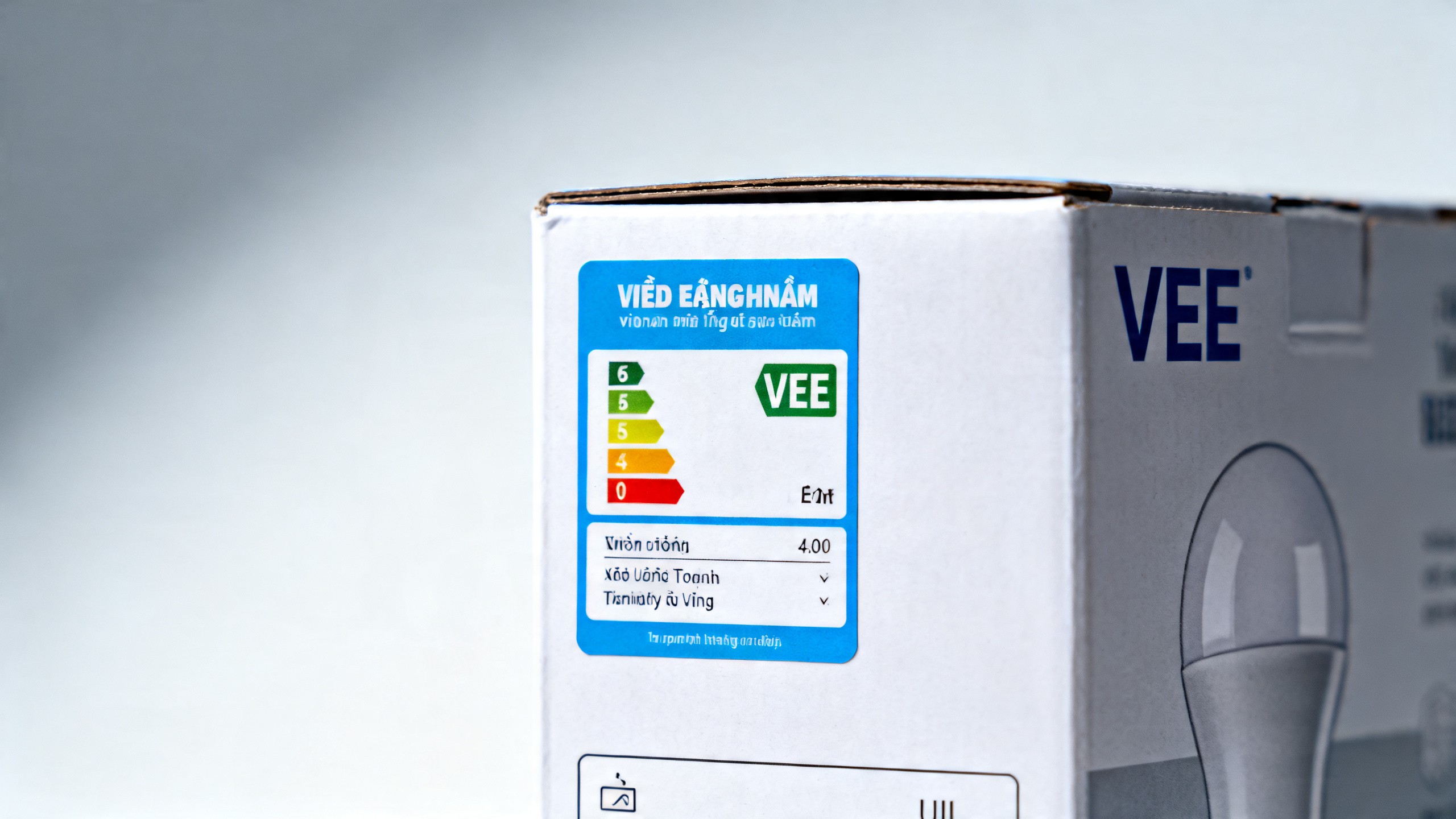
Starting April 1, 2026, Vietnam’s Ministry of Industry and Trade (MOIT) will enforce Decree No. 18/2026, mandating Vietnamese-English bilingual labeling on national energy efficiency labels (VEE) for all electronic and electrical products sold in Vietnam—including LED lighting, power adapters, and small household appliances. This requirement directly impacts exporters, OEM manufacturers, importers, and distributors operating across the Vietnam-China electronics supply chain.
Event Overview
Vietnam’s Ministry of Industry and Trade issued Circular No. 18/2026, effective April 1, 2026. It requires all electronic and electrical (E&E) products placed on the Vietnamese market—including LED lamps, power adapters, and small household appliances—to bear the Vietnam Energy Efficiency (VEE) label with text in both Vietnamese and Chinese. Products failing to comply will be prohibited from import and removed from sale. As reported, several importers in Ho Chi Minh City have already suspended acceptance of Chinese-origin batches lacking bilingual labeling, prompting OEM suppliers in China to upgrade packaging and label management systems.
Which Subsectors Are Affected
Direct Trading Enterprises (Exporters & Importers)
These enterprises face immediate compliance pressure at customs clearance and retail listing stages. Non-compliant shipments risk rejection upon entry, leading to delays, storage costs, or forced rework. The requirement applies uniformly to all imported E&E goods—regardless of origin—but given the scale of Chinese exports to Vietnam, firms sourcing from China are disproportionately affected.
Contract Manufacturing & OEM Firms (China-based)
OEM producers supplying Vietnamese-bound E&E products must now integrate bilingual label design, printing, verification, and version control into their packaging workflows. Unlike single-language labels, bilingual VEE labels require layout validation for both scripts, alignment with Vietnamese regulatory typography rules, and traceability across production batches—adding operational complexity beyond standard CE or CCC labeling.
Channel & Distribution Operators (Wholesalers, Retailers, E-commerce Platforms)
Distributors and online sellers in Vietnam must verify label compliance before shelf placement or product listing. Inventory audits may increase as enforcement ramps up; non-compliant stock risks mandatory withdrawal. Platforms facilitating cross-border sales (e.g., Shopee Vietnam, Lazada Vietnam) may introduce automated label checks or require supplier self-certification ahead of April 2026.
What Relevant Enterprises or Practitioners Should Focus On and How to Respond Now
Monitor official Vietnamese language guidance and technical specifications
The MOIT has not yet published detailed graphic standards, font size requirements, or positioning rules for the bilingual VEE label. Enterprises should track updates from Vietnam’s General Department of Standards, Metrology and Quality (STAMEQ) and the Vietnam Institute of Standards and Industrial Research (VISI), especially any draft technical guidelines expected in late 2025.
Prioritize high-volume, high-risk categories for early label redesign
Based on current enforcement focus, LED lighting, AC-DC adapters, and plug-in kitchen appliances represent priority categories due to their prevalence in Vietnamese retail and relatively high energy consumption profiles. Firms should initiate bilingual label prototyping and internal compliance reviews for these SKUs no later than Q3 2025.
Distinguish between policy mandate and implementation readiness
While the legal effective date is April 1, 2026, customs authorities and provincial market surveillance agencies may adopt phased enforcement. Early-stage inspections could emphasize documentation (e.g., test reports, label artwork approvals) over physical label scrutiny. Companies should avoid assuming a grace period—and instead treat April 2026 as a hard deadline for full operational readiness.
Update supplier agreements and quality assurance protocols
Importers and brand owners should revise purchase orders and quality clauses to explicitly assign responsibility for bilingual label compliance to OEMs or packaging vendors. Internal QA checklists must include bilingual VEE verification at pre-shipment inspection points, with documented evidence retained for potential audit requests.
Editorial Perspective / Industry Observation
From an industry perspective, this regulation is better understood as a signal of Vietnam’s broader regulatory maturation—not merely a labeling update. The inclusion of Chinese text reflects both practical trade reality (the dominance of Chinese-sourced E&E goods) and a deliberate step toward aligning technical regulation with actual supply chain practices. Analysis来看, it also suggests increasing coordination between Vietnam’s MOIT and STAMEQ on enforcement capacity building, particularly for imported goods. Observation来看, the timing—introduced in early 2026 but effective only from April—indicates policymakers anticipate a transition period, though they are not formally granting one. Current more appropriate interpretation is that this is a binding requirement with near-term operational consequences, not a consultative proposal.
Concluding, this measure underscores Vietnam’s shift toward harmonized, enforceable energy efficiency governance—and signals growing expectations for foreign suppliers to adapt labeling and documentation systems to local regulatory language and procedural norms. It is not an isolated compliance item, but rather an indicator of tightening technical market access conditions across Southeast Asia’s fastest-growing electronics markets.
Information Sources:
• Vietnam Ministry of Industry and Trade (MOIT), Circular No. 18/2026/TT-BCT
• Public statements from Ho Chi Minh City-based importers (as cited in industry briefings)
Note: Technical specifications for bilingual VEE label layout, font, and verification procedures remain pending official publication and are subject to ongoing monitoring.
Related News
- Vietnam Enforces Bilingual Energy Label for E&E Products from Apr 2026Apr 17, 2026Vietnam mandates bilingual Vietnamese-English energy labels for E&E products from Apr 2026—critical for exporters, OEMs & importers in the Vietnam-China supply chain.
- Indonesia Mandates CNAS Lab Reports for Imported Building Materials from July 2026Apr 17, 2026Indonesia mandates CNAS lab reports for imported building materials from July 2026 — critical for ceramics, fire doors & waterproofing. Act now to ensure compliance and market access.
- USTR Launches Section 301 Review on Chinese WearablesApr 17, 2026USTR Launches Section 301 Review on Chinese Wearables — key implications for TWS earbuds, smartwatches & health bands. Stay ahead of tariffs, compliance shifts & supply chain risks.
- IEC 62368-1:2026 Published — Export Compliance Deadline Q1 2027Apr 17, 2026IEC 62368-1:2026 is live — meet the Q1 2027 export compliance deadline for AV/IT equipment in EU, UK, Korea & more. Act now to avoid market access disruption.
Related News
- 00
0000-00
Red Sea Tensions Lift Asia-Europe Freight Costs 23% Weekly - 00
0000-00
Shanghai Port Launches Export Compliance Pre-Check Channel - 00
0000-00
Vietnam Enforces Bilingual Energy Label for E&E Products from Apr 2026 - 00
0000-00
Indonesia Mandates CNAS Lab Reports for Imported Building Materials from July 2026 - 00
0000-00
USTR Launches Section 301 Review on Chinese Wearables
Policy Review Desk
Weekly Insights
Stay ahead with our curated technology reports delivered every Monday.