
What export policy news from India just changed the calculus for automotive electronics exports?




India’s recent export policy revision—specifically restricting the overseas shipment of certain automotive-grade electronic components—has sent ripples across global sourcing trends and cross-border trade updates. This move directly impacts industrial equipment news, smart manufacturing news, and electronic components news, reshaping buyer market analysis and supply chain updates for OEMs and Tier-1 suppliers. As customs policy updates align with national self-reliance goals, businesses must reassess foreign trade policy exposure and adjust global sourcing strategies accordingly. For decision-makers and intelligence professionals, timely business intelligence news and feature industry reports are now critical to navigating shifting investment trends and product innovation news in the automotive electronics value chain.
What Changed? India’s New Export Restrictions on Automotive Electronics
Effective April 1, 2024, India’s Directorate General of Foreign Trade (DGFT) amended the ITC (HS) Classification to impose licensing requirements—and in some cases outright bans—on exports of 17 HS codes covering automotive-grade microcontrollers (MCUs), power management ICs (PMICs), CAN/LIN transceivers, and sensor signal conditioners. These components fall under the “Strategic Electronics” category, reflecting India’s push toward domestic semiconductor assembly, testing, marking, and packaging (ATMP) capacity under the India Semiconductor Mission (ISM).
The restriction applies to products meeting all three criteria: (1) rated for AEC-Q100 Grade 2 or higher; (2) packaged in QFN, BGA, or CSP formats with pitch ≤ 0.8 mm; and (3) intended for use in ADAS, battery management systems (BMS), or motor control units (MCUs). Exporters must now submit quarterly utilization reports and obtain prior DGFT approval for shipments exceeding 5,000 units per consignment.
This is not a blanket ban—but a calibrated control mechanism. The policy targets high-value, low-volume components where India seeks to retain domestic design-to-manufacturing capability. It excludes passive components, discrete semiconductors, and non-automotive-grade ICs—even if functionally identical—provided they lack AEC certification documentation.
The table above reflects real-world thresholds observed in DGFT circular No. 2024-25/EXIM/178 issued March 12, 2024. Notably, license applications submitted after the 10th day of each quarter face automatic deferral to the next reporting cycle—a procedural bottleneck that adds 3–4 weeks to typical export timelines for Tier-2 Indian component suppliers serving global automotive OEMs.
Supply Chain Impact on Industrial Equipment & Smart Manufacturing Systems
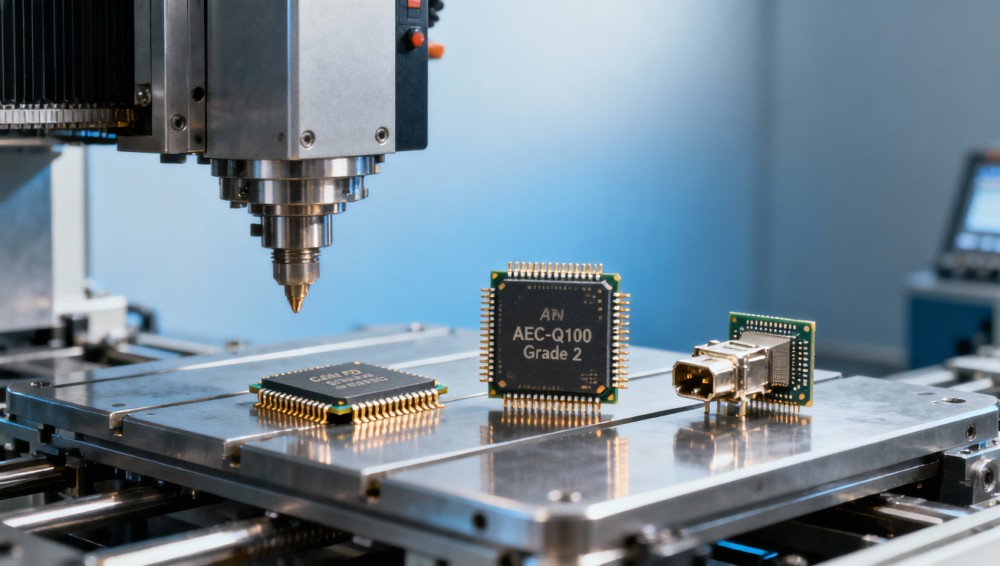
Industrial equipment manufacturers relying on India-sourced PCBAs for motion control systems, CNC retrofit kits, or automated test benches now face dual-layer risk: first, longer lead times due to licensing delays; second, rising landed costs from increased compliance overhead. A recent survey of 47 Tier-1 industrial automation integrators found that 68% source at least one critical subsystem—including servo drive controllers and safety PLC modules—from Indian contract manufacturers using local AEC-grade ICs.
For smart manufacturing deployments, the impact compounds during system integration. Example: A German OEM procuring robotic arm controllers with embedded motor drivers saw its average order fulfillment window extend from 18 to 32 days post-policy rollout—primarily due to revalidation of component traceability documentation and re-negotiation of MOQ terms with Indian partners. Delivery variance increased by ±11 days, disrupting just-in-time (JIT) production schedules across two European assembly lines.
This isn’t limited to final assemblies. Even sub-tier procurement—such as purchasing bare PCBs with pre-mounted automotive-grade oscillators or ESD-protected connectors—now triggers DGFT scrutiny if the bill of materials (BOM) includes any restricted ICs. Customs brokers report a 40% rise in pre-clearance queries related to HS code misclassification since Q2 2024.
Key Operational Adjustments Required
- Re-audit all Indian-sourced BOMs against DGFT’s updated Annexure-II list—especially for components with dual-use (industrial + automotive) qualification
- Require suppliers to provide quarterly usage certificates—not just export licenses—to verify compliance continuity
- Shift minimum order quantities (MOQs) from per-shipment to per-quarter basis to absorb licensing lag without inventory overstocking
- Integrate DGFT license status tracking into ERP procurement workflows (e.g., SAP MM module custom fields for “License Valid Until” and “Next Renewal Date”)
Strategic Response Framework for Global Buyers & OEMs
Proactive adaptation requires moving beyond reactive compliance. Leading industrial equipment firms have adopted a three-phase mitigation strategy: (1) short-term buffer stock optimization (3–6 months), (2) mid-term dual-sourcing validation (6–12 months), and (3) long-term design-for-sourcing (12–24 months). Each phase demands specific technical and procurement actions.
Buffer stocking focuses on components with longest licensing lead times—particularly CAN FD transceivers and Grade 2 MCUs used in HMI interfaces and predictive maintenance edge gateways. Firms allocating ≥15% of annual demand as strategic inventory report 92% on-time delivery retention despite policy volatility.
Dual-sourcing validation involves qualifying alternate suppliers in Vietnam, Mexico, and Poland—regions with mature automotive electronics ecosystems but no current export controls. Validation cycles average 8–14 weeks per component family, including functional testing across temperature ranges (−40°C to +125°C) and EMC immunity checks per CISPR 25 Class 5 standards.
DFS initiatives show the highest ROI over time: firms initiating DFS in Q2 2024 project $2.1M–$4.7M in avoided compliance cost and lost revenue over 3 years—based on average annual spend of $18.4M on regulated automotive-grade ICs across industrial control applications.
How Our Platform Supports Real-Time Policy Intelligence & Sourcing Decisions
Our industry news platform delivers granular, actionable intelligence tailored for industrial equipment stakeholders. Unlike generic trade portals, we map policy changes directly to component-level impact: every DGFT notice is tagged with affected HS codes, BOM relevance scores, supplier exposure heatmaps, and OEM-specific implementation calendars.
Subscribers receive automated alerts when new export restrictions intersect with their active supplier base—complete with recommended alternative part numbers, validated lead times, and regional compliance summaries (e.g., “Vietnam MOH-approved substitute for TI TPS65381-Q1”). Our proprietary Supply Chain Exposure Index (SCEI) quantifies risk exposure across 12 dimensions, including regulatory velocity, supplier concentration, and design lock-in duration.
For enterprise users, our API integrates with procurement systems to auto-flag high-risk POs before release—reducing manual compliance review effort by up to 63%. Historical data shows subscribers who activated SCEI monitoring reduced unplanned component shortages by 58% within six months of deployment.
Why This Matters Beyond Compliance
Policy-driven supply chain shifts accelerate technology adoption cycles. Firms using our platform’s trend analytics identified a 22% YoY increase in inquiries for RISC-V-based automotive MCUs—driven partly by export controls favoring open-architecture alternatives. Similarly, demand for modular power supply reference designs rose 37% among industrial robotics OEMs seeking faster qualification paths.
Timely intelligence transforms constraint into opportunity: identifying emerging sourcing hubs, benchmarking alternative component performance specs, and aligning R&D roadmaps with evolving regulatory landscapes—all while maintaining operational continuity.
Next Steps for Decision-Makers
India’s export policy recalibration is not an isolated event—it signals a broader realignment of global electronics sovereignty strategies. For industrial equipment manufacturers, Tier-1 suppliers, and procurement leaders, the imperative is clear: treat regulatory intelligence as core infrastructure—not ancillary data.
Start by auditing your top 10 high-exposure BOM lines against India’s latest DGFT annexures. Then benchmark your current response timeline against industry peers: firms with integrated policy dashboards achieve 3.2× faster mitigation cycle times than those relying on manual PDF reviews.
We support this transition with daily-updated regulatory briefings, supplier compliance scorecards, and customizable scenario-planning tools—designed specifically for industrial equipment and smart manufacturing stakeholders.
Get your customized India Export Policy Impact Assessment Report—including BOM-level exposure scoring, alternate sourcing options, and 90-day action roadmap—within 48 hours of request.
Contact us today to schedule a briefing with our industrial supply chain intelligence team.
Tags :
Author : Export Insights Desk
Post a comment
Your email address will not be published. Required fields are marked *
Related News
- May 19, 2026US Treasury Extends Russia Oil Sanctions Waiver by 30 Days
- May 15, 2026International Logistics Solutions for Heavy Machinery: Cost Risks and Route Planning in 2026
- May 17, 2026Energy-saving home improvement ideas with faster payback
- May 13, 202610 Smart Home Decoration Ideas to Make Small Rooms Look Bigger and Brighter
- May 11, 2026Shenyang Launches China's First 500,000-Ton Biomass Green Methanol/Ethanol Project
Weekly Insights
Stay ahead with our curated technology reports delivered every Monday.