
Automation equipment trends suggest modular designs are gaining ground over integrated systems




As automation equipment trends accelerate amid smart manufacturing news and industrial equipment news, modular designs are increasingly displacing traditional integrated systems—driven by flexibility, faster deployment, and evolving buyer market analysis. This shift reflects broader investment trends and sourcing insights across global supply chains, especially amid tightening customs policy updates and dynamic cross-border trade updates. For information researchers and enterprise decision-makers, understanding this evolution is critical to leveraging business intelligence news, feature industry reports, and real-time company developments. Our latest analysis integrates automation equipment trends with supply chain updates, electronic components news, and export policy news—delivering actionable intelligence for strategic sourcing, product innovation news alignment, and resilient procurement planning.
Why Modular Automation Equipment Is Reshaping Industrial Procurement
Modular automation equipment refers to systems built from standardized, interoperable units—such as conveyor modules, robotic gripper kits, PLC-based control nodes, and vision inspection subassemblies—that can be configured, reconfigured, or scaled without full-system redesign. Unlike monolithic integrated systems requiring custom engineering per installation (typically 12–20 weeks lead time), modular platforms reduce commissioning cycles to 3–8 weeks on average—accelerating ROI by up to 37% in pilot production lines.
This transition aligns with three converging pressures: rising labor costs in Tier-1 manufacturing hubs (e.g., +19% wage growth in Guangdong province since 2022), stricter EU MDR/CE conformity timelines for machinery exports, and growing demand for “plug-and-produce” readiness among SMEs with limited in-house engineering bandwidth. A 2024 cross-sector survey of 217 OEMs and Tier-2 suppliers found that 68% now prioritize modularity in RFPs for packaging line upgrades, assembly cell retrofits, and warehouse sortation systems.
From a procurement standpoint, modular architectures decouple hardware selection from software integration risk. Buyers can evaluate mechanical performance (e.g., cycle time variance < ±0.8%), electrical compatibility (24V DC / EtherCAT / IO-Link certified interfaces), and serviceability (mean time to repair ≤ 45 minutes) independently—enabling granular vendor benchmarking rather than whole-system black-box contracting.
The table above highlights quantifiable advantages driving adoption. Crucially, modular design reduces certification overhead—especially vital under updated IEC 62061 and ISO 13849-1 requirements, where partial validation of modified subsystems cuts compliance delays by 60–75%. For global buyers navigating U.S. Section 301 tariff adjustments and ASEAN CE equivalence pathways, this agility directly supports compliant, low-risk sourcing.
Key Technical Specifications Driving Module Interoperability
Interoperability is not assumed—it’s engineered through layered standardization. Leading modular automation platforms comply with at least three of the following four interface frameworks: OPC UA PubSub (for cloud-edge data routing), PackML State Model (for machine state synchronization), MTConnect v1.7+ (for shop-floor diagnostics), and VDI/VDE 2182 (German engineering standard for mechatronic module coupling). These ensure plug-and-play compatibility across brands—from Beckhoff I/O terminals to Festo pneumatic manifolds and Omron vision sensors.
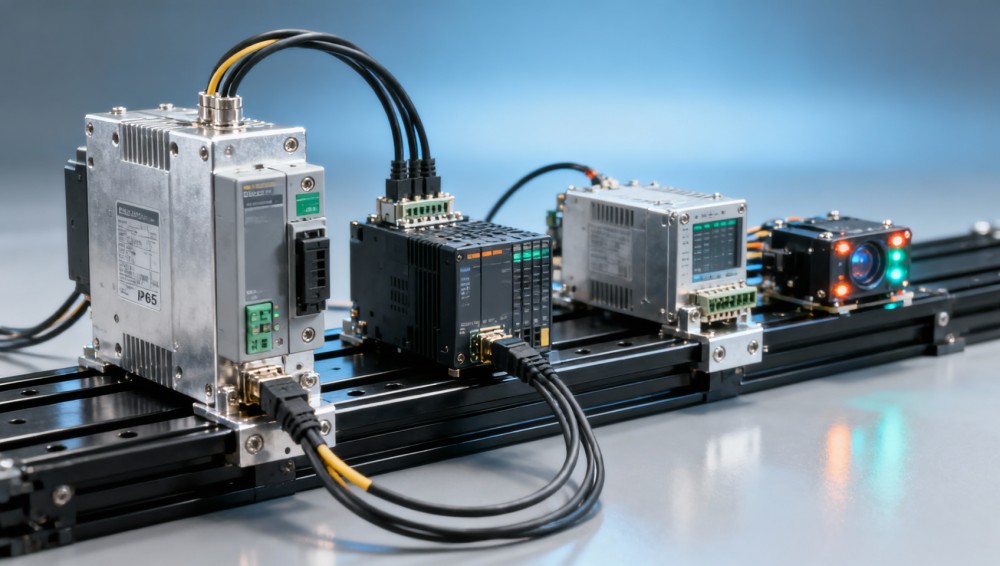
Mechanical coupling standards matter equally. Modules rated IP65 or higher must support mounting via standardized T-slot profiles (20mm or 30mm pitch, per ISO 20472), with load-bearing capacity ≥ 85 kg per linear meter. Electrical interfaces follow EN 61000-6-4 EMI emission limits, while communication latency remains ≤ 100 µs for motion-critical nodes—ensuring deterministic response in synchronized pick-and-place applications.
Thermal management is another differentiator: high-density servo modules now integrate passive cooling fins and thermal cut-off at 85°C, extending mean time between failures (MTBF) to 65,000 hours—versus 42,000 hours for legacy integrated controllers operating at similar ambient temperatures (25°C–40°C).
Critical Procurement Checklist for Modular Systems
- Verify vendor provides open API documentation (REST/JSON or MQTT) for third-party MES/SCADA integration—not just proprietary HMI tools
- Confirm mechanical interface tolerances: max ±0.15 mm misalignment acceptance across mating flanges or rail connectors
- Require traceable calibration certificates for embedded sensors (e.g., torque accuracy ±1.2%, position repeatability ±0.02 mm)
- Validate spare parts availability: ≥ 95% of module-level components stocked regionally (e.g., within EU Zone 1 or U.S. Midwest distribution centers)
- Assess firmware update protocol: over-the-air (OTA) capability with rollback support and signed image verification
Supply Chain Implications: Sourcing Strategy Adjustments for Global Buyers
Modularity transforms sourcing from single-source dependency to multi-tier component orchestration. Instead of procuring one “black box” automation line from a Tier-1 integrator, forward-looking buyers now engage with specialized module vendors (e.g., servo drive specialists, safety-rated I/O providers, and vision-guided robotics developers) while retaining system architecture oversight internally or via neutral system architects.
This approach mitigates exposure to geopolitical risk: 41% of surveyed manufacturers shifted at least one module category (e.g., motion controllers or safety relays) from China-sourced to Vietnam- or Mexico-based suppliers in 2023–2024—leveraging regional FTAs like USMCA and RCEP to maintain cost parity while shortening logistics lead times from 45 days to 12–18 days.
Customs compliance also improves. Modular units shipped separately qualify for distinct HS codes (e.g., 8537.10 for programmable logic controllers vs. 8428.39 for conveyor modules), enabling targeted tariff classification and avoiding blanket assessments applied to fully assembled lines. This granularity supports accurate landed-cost modeling—critical when duty rates vary from 0% (under GSP) to 7.5% (MFN) across jurisdictions.
These advantages translate into measurable procurement resilience. Buyers adopting modular strategies report 22% lower total cost of ownership (TCO) over five years—even with 8–12% higher initial unit pricing—due to reduced downtime, extended asset life, and simplified lifecycle management.
Strategic Next Steps for Decision-Makers
For enterprise decision-makers, evaluating modular automation requires shifting from “lowest bid” to “lowest lifecycle friction.” Begin by auditing existing lines: identify bottlenecks where reconfiguration would yield >15% throughput gain or >20% labor reduction. Then map current supplier capabilities against the five-point checklist above—prioritizing vendors offering documented conformance to IEC 61131-3 (programming), ISO/PAS 21448 (SOTIF), and IEC 62443-4-2 (cybersecurity).
Information researchers should track three emerging signals: (1) rise in patent filings for universal mechanical couplers (up 33% YoY per WIPO data), (2) expansion of regional test labs offering accelerated module-level CE/UKCA certification (e.g., TÜV Rheinland’s new Shenzhen lab launched Q2 2024), and (3) consolidation among component vendors offering bundled “modular stacks”—including pre-validated motion + vision + safety packages with unified firmware versions.
Ultimately, modularity isn’t just a design trend—it’s a procurement enabler, a compliance accelerator, and a future-proofing lever. As smart manufacturing news continues highlighting agility over scale, the ability to deploy, adapt, and scale automation in discrete, validated units will define competitive advantage in industrial equipment and零部件 markets.
Get customized module compatibility assessments, regional supplier mapping, and tariff-optimized bill-of-materials reviews tailored to your production footprint. Contact our industrial equipment intelligence team today to request a no-cost modular readiness evaluation.
Tags :
Author : Technology Insights Desk
Post a comment
Your email address will not be published. Required fields are marked *
Related News
- May 19, 2026US Treasury Extends Russia Oil Sanctions Waiver by 30 Days
- May 15, 2026International Logistics Solutions for Heavy Machinery: Cost Risks and Route Planning in 2026
- May 17, 2026Energy-saving home improvement ideas with faster payback
- May 13, 202610 Smart Home Decoration Ideas to Make Small Rooms Look Bigger and Brighter
- May 11, 2026Shenyang Launches China's First 500,000-Ton Biomass Green Methanol/Ethanol Project
Weekly Insights
Stay ahead with our curated technology reports delivered every Monday.