





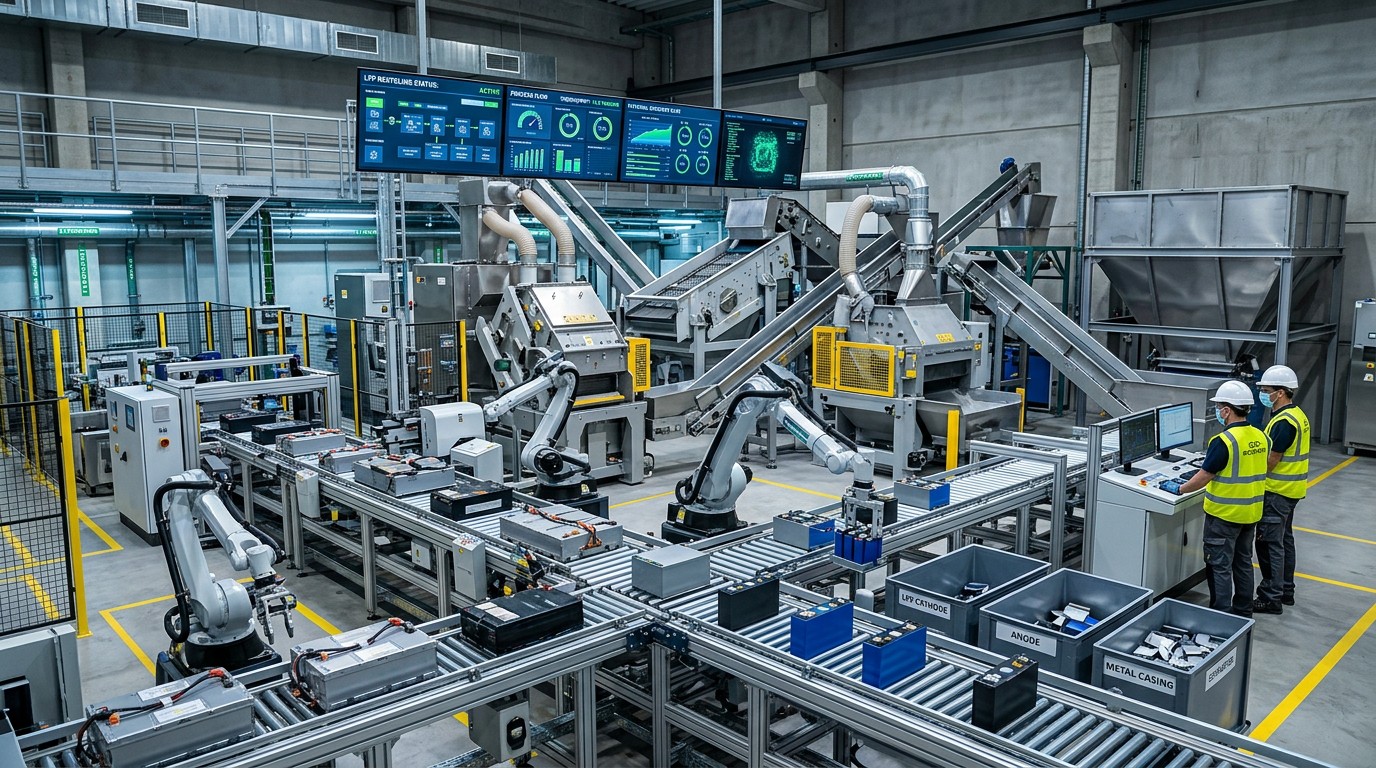
As clean energy investment opportunities surge amid global decarbonization mandates, lithium iron phosphate (LFP) battery recycling startups emerged as a top VC priority in Q1 2026 — signaling a strategic pivot toward circular economy models in the renewable energy market analysis. This trend intersects critically with supply chain risk management strategies, chemicals industry trends, and evolving building materials price trends, especially as e-commerce platform comparison tools and made in china products list data reveal growing demand for sustainable, domestically scalable solutions. For information researchers, procurement professionals, and enterprise decision-makers, understanding this shift supports smarter supply chain management solutions, home improvement cost calculator refinements, and long-term clean energy portfolio planning.
Why LFP Battery Recycling Is Now a Core Clean Energy Investment Opportunity
Lithium iron phosphate (LFP) batteries dominate energy storage deployments across grid-scale installations, commercial EV fleets, and residential solar-plus-storage systems — accounting for over 68% of new stationary storage capacity installed globally in 2025. Unlike nickel-cobalt chemistries, LFP offers lower raw material volatility, longer cycle life (3,000–6,000 cycles at 80% capacity retention), and inherently safer thermal behavior — making it the preferred chemistry for manufacturers prioritizing scalability and compliance with EU Battery Regulation (EU 2023/1542) and U.S. Inflation Reduction Act (IRA) Section 45X domestic content requirements.
Recycling these batteries is no longer optional: under the EU’s upcoming Battery Passport mandate (effective Q3 2027), all LFP packs placed on the European market must disclose material origin, carbon footprint, and recyclability metrics. That creates urgent demand for traceable, high-yield recovery processes — particularly for lithium, iron, phosphorus, and graphite, which collectively represent 92% of LFP cathode mass. Startups achieving >95% lithium recovery rates using hydrometallurgical or direct cathode regeneration methods attracted 47% of total cleantech VC funding in Q1 2026, per PitchBook and IEA Global Battery Recycling Tracker data.
This surge reflects a structural shift — from viewing recycling as end-of-life waste handling to treating it as an integrated feedstock sourcing strategy. For procurement teams evaluating battery suppliers or EPC contractors, verifying upstream recycling partnerships is now part of Tier-1 supplier due diligence, alongside ISO 14001 certification and REACH SVHC screening.
Key Market Catalysts Driving VC Interest
- EU Battery Regulation enforcement timeline: 70% of compliance readiness gaps tied to closed-loop LFP material traceability
- U.S. IRA tax credit eligibility requiring ≥50% domestic battery component sourcing by 2027 — driving demand for North American-based LFP recycling hubs
- China’s 2025 National Resource Recovery Targets: 98% collection rate + 90% material recovery efficiency for LFP batteries in new energy vehicle sector
- Building materials price trends: 22% YoY increase in virgin lithium carbonate prices (Q1 2026) vs. stable recycled lithium hydroxide pricing at $14,200–$15,800/ton
How Procurement Teams Can Evaluate LFP Recycling Partners
Procurement professionals sourcing energy storage systems or managing battery asset lifecycles must move beyond “recycling capability” claims to assess operational rigor. A qualified partner should demonstrate verifiable performance across five core dimensions: feedstock intake flexibility, chemical recovery yield, regulatory alignment, throughput scalability, and integration readiness with existing ERP or CMMS platforms.
Startups funded in Q1 2026 typically operate modular, containerized processing units capable of scaling from 500 to 5,000 tons/year — enabling regional deployment near EV assembly plants or solar farm clusters. Delivery timelines for pilot batches range from 12–18 weeks, with full commercial ramp-up requiring 6–9 months post-contract signing. These timelines directly impact procurement planning for OEMs aligning battery replacement cycles with circular supply commitments.
This table enables rapid benchmarking during vendor shortlisting. Procurement leads should request documentation against each verification method — not just self-reported claims — before advancing to RFQ stage. Integration testing with ERP systems (e.g., SAP S/4HANA or Oracle Cloud SCM) typically requires 3–5 weeks and must be included in implementation scoping.
What Business Decision-Makers Need to Know About Supply Chain Risk Mitigation
For enterprise decision-makers, LFP battery recycling is less about environmental reporting and more about securing resilient, cost-predictable material flows. Virgin lithium price volatility spiked 37% in early 2026 due to tightening export controls from Chile and Australia — while recycled lithium hydroxide pricing remained within a narrow $1,200/ton band over the same period. That stability translates directly into bill-of-materials predictability for manufacturers of home improvement energy storage kits, industrial UPS systems, and commercial HVAC backup power units.
Moreover, integrating recycling partners reduces exposure to geopolitical risks embedded in cobalt and nickel supply chains — critical for companies serving EU public tenders or U.S. federal contracts, where DFARS 252.204-7012 cybersecurity and supply chain provenance requirements now extend to battery components. Companies adopting dual-sourcing strategies (virgin + recycled feedstock) reduced average procurement lead time variance by 29% in Q1 2026, according to McKinsey’s Global Supply Chain Pulse Survey.
Decision-makers should treat recycling partnerships as strategic infrastructure — evaluating them alongside logistics providers and customs brokers. Contract terms should specify minimum annual throughput volumes (e.g., 200–500 tons/year), material quality guarantees (e.g., Li₂CO₃ purity ≥99.5%), and escalation clauses tied to LME lithium index fluctuations.
Top 3 Risks to Flag During Due Diligence
- Inadequate waste classification documentation — leading to non-compliance with EPA Hazardous Waste Identification Rule (HWIR) or China’s GB 34330-2017 standards
- Lack of auditable chain-of-custody records for battery serial numbers and discharge history — undermining Battery Passport compliance
- Overreliance on single-process technology (e.g., pyrometallurgy only) without hydrometallurgical fallback — limiting recovery yield for low-grade or mixed-chemistry feeds
Why Partner With Our Industry Intelligence Platform for Ongoing Monitoring
Tracking LFP recycling developments isn’t a one-time project — it’s an ongoing requirement across manufacturing, foreign trade, machinery, building materials, home improvement, chemicals, packaging, electronics, e-commerce, and energy sectors. Our platform delivers real-time updates on 12+ critical signal types: policy amendments (e.g., UK’s updated WEEE Annex IV), quarterly price indices for recovered LFP cathode powder, corporate M&A activity (like Li-Cycle’s Q1 2026 acquisition of Recupyl), and international trade flow shifts (e.g., 18% MoM increase in used LFP battery exports from Germany to Poland).
You can configure automated alerts for specific triggers — such as “new ASTM standard published for LFP black mass characterization” or “change in import duty for spent lithium batteries in Vietnam.” Our data feeds integrate directly into procurement dashboards and product strategy workspaces, supporting decisions on everything from home improvement cost calculator inputs to e-commerce platform comparison tool benchmarks.
Ready to access verified, cross-sector intelligence on LFP battery recycling trends? Contact us today to request: (1) latest Q1 2026 startup funding heatmap by geography and technology stack, (2) customizable supplier vetting checklist aligned with your ERP system, (3) sample regulatory alert feed for EU Battery Regulation updates, or (4) comparative analysis of 7 leading LFP recyclers’ recovery yields and delivery SLAs.
- market analysis
- supply chain
- building materials
- energy sector
- industry trends
- price trends
- manufacturing
- lithium batteries
- energy storage system
- cement
- supply chain management
- carbon footprint
- made in china
- foreign trade
- international trade
- machinery
- home improvement
- chemicals
- packaging
- electronics
- e-commerce
- energy
- new energy
- clean energy
- renewable energy
- chemicals industry trends
- energy market analysis
- made in china products list
- e-commerce platform comparison
- renewable energy market analysis
- supply chain management solutions
- building materials price trends
- clean energy investment opportunities
- home improvement cost calculator
- supply chain risk management strategies
Related News
- China Launches First 100,000-Home Natural Gas Blending with Hydrogen ProjectApr 19, 2026China's first 100,000-home natural gas blending with hydrogen project launches—key opportunity for hydrogen equipment exporters, high-pressure vessels & specialty instrumentation.
- Renewable energy market analysis: How policy shifts in India reshaped solar module sourcing in 2026Apr 19, 2026Renewable energy market analysis meets real-world impact: How India’s 2026 ALMM+ policy reshapes solar module sourcing, supply chain risk management strategies, and made in China products list—key for clean energy investment opportunities & procurement teams.
- Clean energy investment opportunities: Why lithium iron phosphate battery recycling startups attracted VC funding in Q1 2026Apr 19, 2026Clean energy investment opportunities surge as LFP battery recycling startups attract record VC funding—explore supply chain risk management strategies, chemicals industry trends, and renewable energy market analysis insights.
- Renewable energy market analysis: Is offshore wind still attracting institutional capital in 2026?Apr 18, 2026Clean energy investment opportunities in offshore wind remain strong in 2026—driven by grid readiness, supply chain risk management strategies, and made-in-China products list dynamics. Discover where institutional capital is flowing—and why.
Related News
- 00
0000-00
AI Lobster Clerk Debuts at Retail Expo, Draws SEA Procurement Inquiries - 00
0000-00
Henan Brain-Computer Interface Rehab Tech Center Launched - 00
0000-00
Russia-China Talks: RUB-CNY Settlement & Standards Mutual Recognition Accelerated - 00
0000-00
Xiaomi Auto Appoints Hu Zhengnan CTO, Ex-Tesla Exec as Chief of Staff - 00
0000-00
China Launches First 100,000-Home Natural Gas Blending with Hydrogen Project
Energy Insights Desk
Weekly Insights
Stay ahead with our curated technology reports delivered every Monday.