





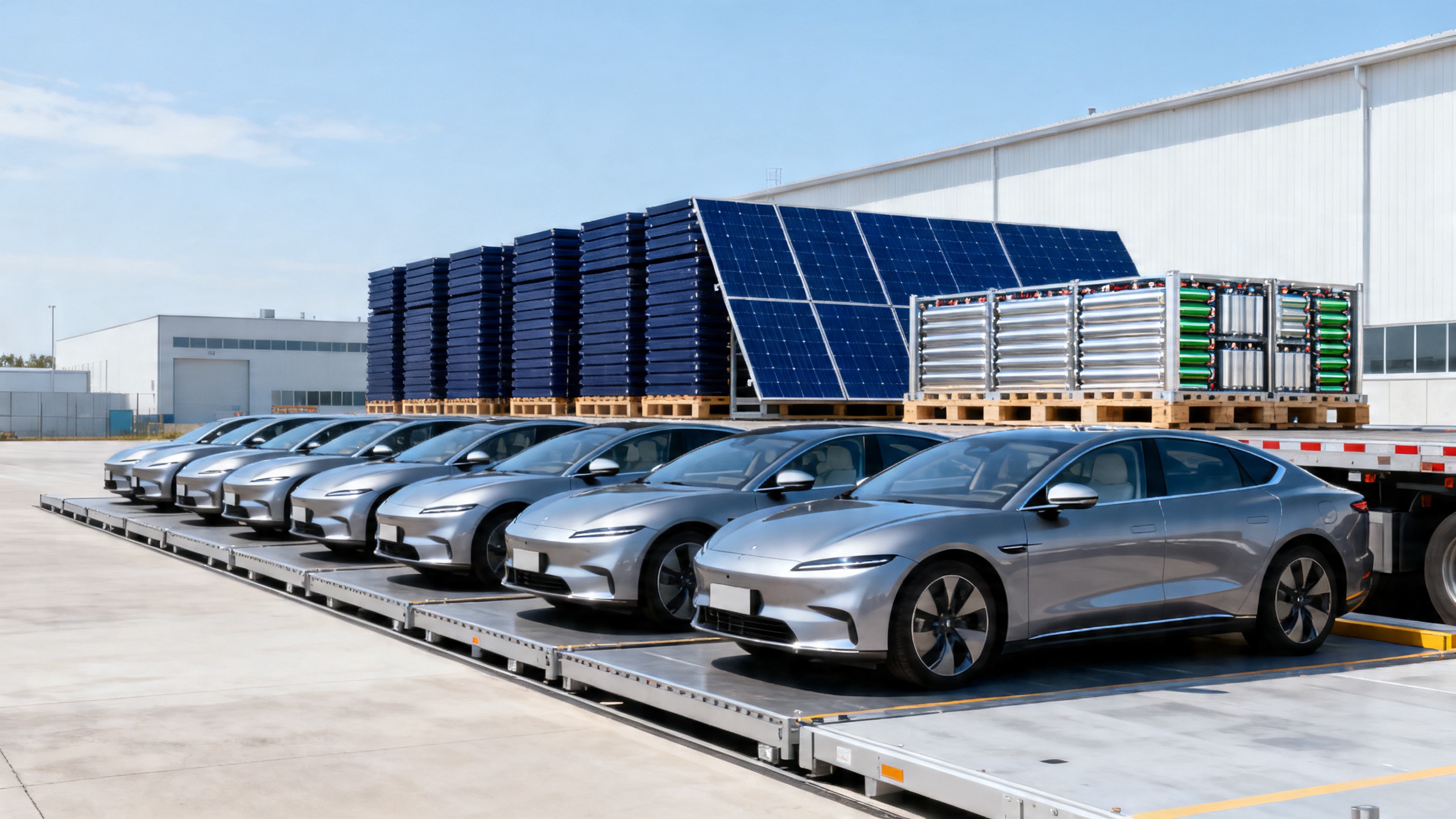
China’s export structure underwent a measurable shift in Q1 2026 (April 1–30, 2026), with high-value机电 and green-energy products—particularly lithium batteries, solar cells, and electric vehicles—accounting for 58.3% of total exports, the highest share on record. This development carries direct implications for international importers, OEMs, contract manufacturers, and supply chain service providers assessing long-term procurement stability, technical compatibility, and ESG compliance capacity.
Event Overview
According to data released by China’s National Bureau of Statistics on April 16, 2026, China’s goods export value in Q1 2026 totaled USD 732.8 billion, up 6.2% year-on-year. Exports of the so-called “New Three” products—machinery & electrical equipment, lithium batteries, solar cells, and electric vehicles—grew 19.4% year-on-year and accounted for 58.3% of total export value, surpassing 58% for the first time.
Industries Affected
Direct Trading Enterprises
Trading firms sourcing from Chinese exporters face recalibration of product mix and margin structures. As ‘New Three’ items now dominate export volume, traditional low-margin general merchandise faces relative contraction in order flow and logistical priority.
Raw Material Procurement Enterprises
Firms supplying critical inputs—including cathode materials for lithium batteries, polysilicon for solar cells, and rare-earth alloys for EV motors—are seeing sustained demand pressure. However, price volatility and export licensing scrutiny (e.g., for dual-use technologies) may intensify.
Contract Manufacturing & OEM Enterprises
Manufacturers engaged in assembly or subsystem integration for ‘New Three’ products must adapt to tighter technical documentation requirements, extended lead-time planning, and stricter conformity assessments—especially for EU CBAM-adjacent markets and U.S. UFLPA-aligned due diligence.
Supply Chain Service Providers
Cargo forwarders, customs brokers, and logistics platforms handling cross-border shipments of lithium batteries or EVs are encountering heightened classification complexity, updated IATA/IMDG regulations, and increased pre-shipment verification demands—particularly for battery-powered goods classified as Class 9 hazardous materials.
What Relevant Enterprises or Practitioners Should Focus On
Monitor official policy signals beyond headline data
Current statistics reflect realized trade flows—not yet new export controls, subsidy adjustments, or certification mandates. The National Bureau of Statistics release does not indicate whether upcoming Ministry of Commerce guidance will tighten technical export reviews for battery management systems or solar inverters.
Track category- and market-specific shifts—not just aggregate growth
The 19.4% growth in ‘New Three’ exports masks divergent trajectories: EV exports rose 32%, while solar cell shipments grew only 8.7% amid EU anti-subsidy investigations. Importers should segment analysis by product subcategory and destination market rather than rely on composite figures.
Distinguish between statistical momentum and operational readiness
A 58.3% share reflects shipment volume—not necessarily end-market absorption capacity. Buyers should verify whether export growth stems from inventory build-up ahead of anticipated tariff changes or genuine overseas demand expansion—especially in emerging markets where charging infrastructure or grid integration remains underdeveloped.
Prepare documentation and compliance workflows proactively
With ESG reporting expectations rising across key markets (e.g., EU CSRD, U.S. SEC climate disclosures), enterprises sourcing ‘New Three’ products should begin collecting supplier-level carbon intensity data, battery passport-ready material traceability records, and third-party verified recycling claims—before formal requirements take effect.
Editorial Perspective / Industry Observation
From an industry perspective, this milestone is best understood not as a completed structural transition—but as a measurable inflection point in China’s export evolution. The 58.3% share signals growing scale and systemic prioritization of high-tech, low-carbon manufacturing, but does not yet confirm broad-based resilience across all ‘New Three’ subsectors. Analysis来看, the trend reflects both domestic industrial policy continuity and reactive adaptation to external market access conditions—notably tightening environmental and digital governance standards abroad. Current more appropriate interpretation is that it marks a threshold where procurement strategy must shift from ‘product selection’ to ‘systemic capability assessment’—evaluating not just unit cost, but embedded R&D intensity, decarbonization pathways, and regulatory agility.
Conclusion
This data point signifies a quantifiable acceleration in China’s export value chain upgrade—not a one-off anomaly, nor a fully matured outcome. It underscores that global procurement decisions increasingly hinge on technical integration depth and sustainability transparency—not just production volume or price. For stakeholders, it is more accurate to view the 58.3% figure as a benchmark requiring active monitoring, not a stable baseline for long-term planning.
Information Sources
Main source: National Bureau of Statistics of China (data release dated April 16, 2026). Note: Further details on underlying methodology, regional breakdowns, or revised definitions of ‘New Three’ categories remain pending official clarification and are subject to ongoing observation.
Related News
- RCEP e-CO Platform Launches for Faster Export ClearanceApr 16, 2026RCEP e-CO Platform launches April 2026—boosting export clearance for machinery, textiles & food additives. Cut waiting times by 60% with real-time origin verification.
- China's Q1 2026 Export Structure Upgrades: 'New Three' Reach 58.3%Apr 16, 2026China's Q1 2026 export structure upgrades: 'New Three' (EVs, lithium batteries, solar cells) hit 58.3% — key insights for importers, OEMs & supply chain pros.
- Biodegradable packaging isn’t always greener — here’s where it fails in real-world logisticsApr 16, 2026Biodegradable packaging fails in real logistics—discover why coating materials, rubber materials & plastic resins fall short. Get data-driven insights on label materials, paper packaging & specialty chemicals.
- Investment trends in Asian manufacturing hubs show divergence — not just growthApr 16, 2026Explore global sourcing trends, smart manufacturing news & investment trends shaping Asia’s divergent factory landscape—get actionable buyer market analysis & sourcing insights now.
Related News
- 00
0000-00
Indonesia Mandates CNAS Lab Reports for Imported Building Materials from July 2026 - 00
0000-00
China's CPO Optical Module Exports Up 41%; Eoptolink First Global Vendor on US AI Infrastructure White List - 00
0000-00
IEC 62368-1:2026 Published — AV/IT Exporters Must Comply by Q1 2027 - 00
0000-00
Red Sea Tensions Lift Asia-Europe Freight Costs 23% Weekly - 00
0000-00
RCEP e-CO Platform Launches for Faster Export Clearance
Global Trade Insights Desk
Weekly Insights
Stay ahead with our curated technology reports delivered every Monday.