





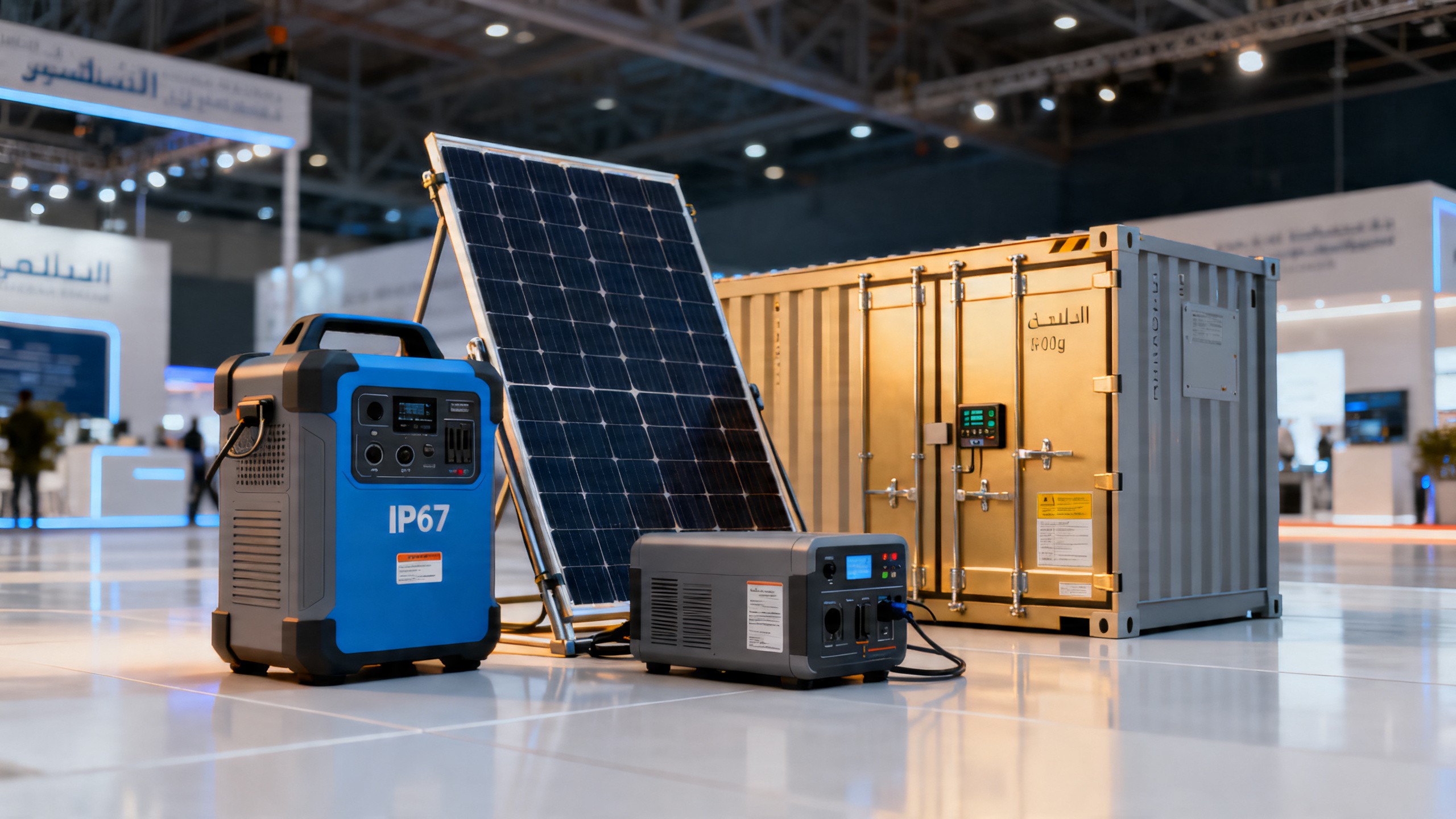
On April 18, 2026 — the opening day of the 139th Canton Fair — procurement delegations from Saudi Arabia, the UAE, and Iraq collectively intensified inquiries for off-grid photovoltaic systems, 20-foot standard energy storage containers, and IP67-rated portable power stations. Key concerns included compliance with UL 1973 and IEC 62619 standards, as well as customs facilitation under the Sharjah Airport International Free Zone (SAIF Zone). Multiple Chinese manufacturers reported that Middle East orders now account for 32% of their total export volume — a notable shift warranting attention from solar component exporters, battery system integrators, and cross-border logistics providers.
Event Overview
The 139th Canton Fair opened on April 18, 2026. On that day, buyers from Saudi Arabia, the United Arab Emirates, and Iraq actively sought quotations for three product categories: photovoltaic off-grid systems, 20-foot standardized energy storage containers, and IP67-rated outdoor portable power stations. Their technical due diligence focused on UL 1973 and IEC 62619 certification requirements. Inquiries also referenced customs efficiency at SAIF Zone. According to publicly shared feedback from several Chinese exhibitors, exports to the Middle East now represent 32% of their total overseas sales.
Which Subsectors Are Affected
Direct Export Trading Firms
These firms face immediate shifts in demand composition and regional concentration. The rise in Middle East–bound orders for integrated energy solutions — rather than standalone components — increases pressure to manage certification alignment, documentation accuracy for SAIF Zone clearance, and post-sale technical support capacity in Arabic-speaking markets.
Manufacturers of Energy Storage Systems & PV Components
Producers of battery packs, inverters, and modular PV kits are affected by tightening technical specifications. The emphasis on UL 1973 (for stationary battery systems) and IEC 62619 (for industrial lithium cells) signals growing regulatory expectations beyond basic CE or CB Scheme conformity. Product labeling, safety testing reports, and bilingual user manuals may become prerequisites for tender eligibility.
Supply Chain & Logistics Service Providers
Firms offering freight forwarding, customs brokerage, and bonded warehousing services must adapt to increased demand for SAIF Zone–aligned documentation and multimodal coordination (e.g., sea-to-air handoffs for urgent mobile power units). The preference for 20-foot standardized containers also implies potential adjustments in container allocation strategies and inland haulage scheduling.
OEM/ODM Contract Manufacturers
Contract producers supporting global brands are seeing upstream specification changes trickle down. Requests for IP67-rated enclosures, desert-grade thermal management, and dual-voltage output configurations are becoming more frequent — affecting design validation timelines, material sourcing (e.g., conformal coatings, gasketing), and factory-level quality audits.
What Enterprises and Practitioners Should Focus On Now
Monitor official updates on SAIF Zone regulatory implementation
While SAIF Zone is cited as a customs advantage, its specific documentation protocols, tariff classifications for hybrid energy products, and inspection frequency remain subject to local authority guidance. Current references are based on buyer-side expectations — not finalized procedural mandates.
Prioritize verification of UL 1973 and IEC 62619 certification status
Many manufacturers hold IEC 62133 or UN38.3 certifications but lack UL 1973 or IEC 62619. These two standards address long-term safety performance in stationary and industrial applications — critical for grid-tied and off-grid energy storage deployments. Confirming current certification scope and identifying gaps is operationally urgent.
Review packaging, labeling, and technical documentation for regional compliance
IP67 rating claims require test evidence traceable to accredited labs; Arabic-language safety warnings and installation instructions are increasingly expected in tenders. Preemptive alignment with GCC Standardization Organization (GSO) marking rules may reduce post-order delays.
Assess inventory and production planning for standardized container-based SKUs
The repeated reference to ‘20-foot standard energy storage containers’ suggests growing preference for drop-in-ready units over custom-engineered solutions. This favors modular, pre-certified designs and may influence raw material procurement cycles and warehouse slotting logic.
Editorial Observation / Industry Perspective
From an industry perspective, this Canton Fair observation is best understood as an early signal — not yet a consolidated trend. The 32% Middle East export share reflects self-reported data from select exhibitors, not a statistically representative sample. However, the convergence of inquiry themes — certification rigor, form factor standardization, and zone-specific customs advantages — points to maturing procurement discipline among Gulf-based buyers. It signals a transition from price-driven commodity sourcing toward value-driven system integration. That shift matters most for firms whose export strategy still relies heavily on generic product listings without embedded compliance or localization readiness.
Conclusion
This Canton Fair snapshot does not indicate a wholesale market pivot, but it does reflect measurable intensification in demand for certified, standardized, and regionally adapted energy storage and solar solutions across key Gulf markets. For stakeholders, the implication is not urgency to restructure globally — but rather precision in adjusting technical compliance posture, documentation workflows, and SKU-level planning for Middle East–targeted offerings. It is better interpreted as a directional cue than a structural inflection point.
Source Attribution
Main source: Public statements and on-site feedback from Chinese exhibitors at the 139th Canton Fair, April 18, 2026. No third-party market research, government reports, or trade association data were used. Areas requiring continued observation include: formal adoption timeline of UL 1973/IEC 62619 as mandatory for Gulf imports; actual clearance processing times at SAIF Zone for energy storage shipments; and whether the 32% Middle East export share is sustained across Q2 2026 shipment data.
Related News
- Canton Fair 2026: Solar, Energy Storage Surge in Middle East OrdersApr 19, 2026Canton Fair 2026 highlights surging Middle East orders for solar & energy storage — UL 1973/IEC 62619 compliance, SAIF Zone customs, and IP67 power stations in demand.
- Made in China products list: What’s newly export-compliant for EU markets in 2026?Apr 18, 2026Made in China products list updated for EU 2026 compliance—covering home decoration ideas, semiconductor industry news, clean energy investment opportunities, and supply chain risk management strategies.
- RCEP e-CO Platform Launched for China-ASEAN Building Materials & MachineryApr 17, 2026RCEP e-CO Platform launched: Fast-track China-ASEAN building materials & machinery exports with 3-day digital origin certification and tariff preferences.
- China’s Q1 2026 Exports Hit Record High, New Energy Goods Surpass 58% ShareApr 17, 2026China’s Q1 2026 exports hit record high—new energy goods (lithium batteries, solar cells,机电 products) now exceed 58% share. Key insights for importers, OEMs & supply chain leaders.
Related News
- 00
0000-00
AI Lobster Clerk Debuts at Retail Expo, Draws SEA Procurement Inquiries - 00
0000-00
Henan Brain-Computer Interface Rehab Tech Center Launched - 00
0000-00
Russia-China Talks: RUB-CNY Settlement & Standards Mutual Recognition Accelerated - 00
0000-00
Xiaomi Auto Appoints Hu Zhengnan CTO, Ex-Tesla Exec as Chief of Staff - 00
0000-00
China Launches First 100,000-Home Natural Gas Blending with Hydrogen Project
Export Insights Desk
Weekly Insights
Stay ahead with our curated technology reports delivered every Monday.